Fishtank Learning
3rd Grade Math
Unit 4: Area
Lesson 11
Objective
Apply the distributive property as a strategy to find the total area of a large rectangle.
Anchor Tasks - Problem 1
Andre is finding the area of this rectangle.

| Andre writes 6 × 7. | He marks the rectangle like this: |
He then writes: |
|
|
6 × (5 + 2) (6 × 5) + (6 × 2) 30 + 12 42 |

a. How are the numbers in Andre’s expressions related to his diagram?
b. How are 6 × 7 and 6 × (5 + 2) related to each other? What about 6 × 7 and (6 × 5) + (6 × 2)?
Anchor Tasks - Problem 2
Write three expressions that represent the area of the rectangle below.

Anchor Tasks - Problem 3
Draw a rectangle on the grid below that matches the given expression.

Problem Set
Target Task - Problem 1
Use the rectangle below to answer Parts (a) and (b).

a. Which equation represents the total number of square feet represented by the rectangle above?
A. 4 × (3 + 2) = 4 + 3 + 2
B. 4 × (3 + 2) = 4 × 3 × 2
C. 4 × (3 + 2) = (4 × 3) × (4 × 2)
D. 4 × (3 + 2) = (4 × 3) + (4 × 2)
b. What is the area of the rectangle above? Show your work.
Target Task - Problem 2
Draw a rectangle that matches the expression in the grid underneath. Then, explain how the diagram represents the expression.

Word Problem
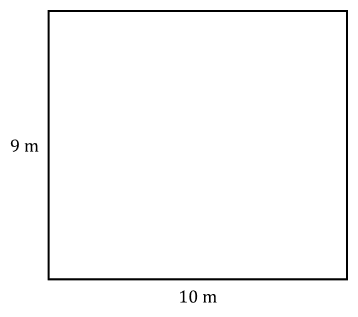
The town needs to know the area of the playground so they can find how much mulch they need to cover it. The layout of the playground is shown below. What is the area of the playground?