view_context: Dynamic page
Place Value to 99
Students develop an understanding of two-digit numbers as groups of tens and ones. They count, read, and write numbers up to 120 and represent quantities with written numerals. Students use models and drawings to build and compare numbers within 99.
Math
Unit 6
1st Grade
Unit Summary
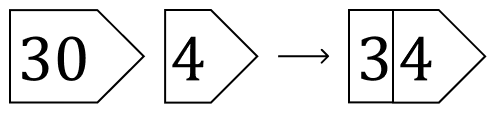
In Unit 6, students develop foundational place value understanding, learning that two-digit numbers represent tens and ones. They count, read, and write numbers up to 120 and represent quantities with numerals. Students use linking cubes, tiny ten frames, and arrow cards to build, compose, and decompose numbers
MP.5
Use appropriate tools strategically.
. Linking cubes, both in stacks of ten and as individual cubes, are used intentionally to allow students to physically compose and decompose tens, preparing them to use more abstract base-ten blocks in subsequent grades. These representations help students to make sense of the base-ten system
MP.7
Look for and make use of structure.
.
In Kindergarten, students composed and decomposed teen numbers into ten ones and additional ones
K.NBT.A.1
Compose and decompose numbers from 11 to 19 into ten ones and some further ones, e.g., by using objects or drawings, and record each composition or decomposition by a drawing or equation (e.g., 18 = 10 + 8); understand that these numbers are composed of ten ones and one, two, three, four, five, six, seven, eight, or nine ones.
. In earlier 1st grade units, they deepened their understanding of ten as a unit while developing strategies for adding and subtracting within 20. This unit extends that work by emphasizing ten as an organizing structure for all two-digit numbers. Students learn that the digits in a two-digit number represent tens and ones, and that numbers like 30 or 50 describe groups of tens with zero ones
1.NBT.B.2
Understand that the two digits of a two-digit number represent amounts of tens and ones. Understand the following as special cases:
. They compare two-digit numbers by tens first, then ones, recording comparisons with “greater than”, “less than”, and the symbols >, <, and =
1.NBT.B.3
Compare two two-digit numbers based on meanings of the tens and ones digits, recording the results of comparisons with the symbols >, =, and <.
.
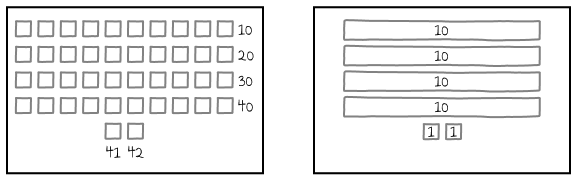
Throughout the unit, students build and represent numbers with concrete and visual models to strengthen their place value understanding. Counting Collections appears repeatedly throughout, giving practice in accurately counting within 120, organizing objects into meaningful groups, and naturally discovering the efficiency of grouping by tens. This also supports representing numbers with drawings: students may begin with one-to-one drawings of objects and gradually move to more efficient forms as shown below. These experiences reinforce number sequence, deepen understanding of tens and ones, and provide authentic contexts for explaining and justifying strategies. MP.3 Construct viable arguments and critique the reasoning of others.
This unit lays essential groundwork for upcoming 1st grade work. Students compose and decompose numbers (e.g., recognizing that 47 can be made with 4 tens and 7 ones or with 3 tens and 17 ones), supporting future flexibility with addition and subtraction 1.NBT.C.4 Add within 100, including adding a two-digit number and a one-digit number, and adding a two-digit number and a multiple of 10, using concrete models or drawings and strategies based on place value, properties of operations, and/or the relationship between addition and subtraction; relate the strategy to a written method and explain the reasoning used. Understand that in adding two-digit numbers, one adds tens and tens, ones and ones; and sometimes it is necessary to compose a ten. 1.NBT.C.5 Given a two-digit number, mentally find 10 more or 10 less than the number, without having to count; explain the reasoning used. 1.NBT.C.6 Subtract multiples of 10 in the range 10-90 from multiples of 10 in the range 10-90 (positive or zero differences), using concrete models or drawings and strategies based on place value, properties of operations, and/or the relationship between addition and subtraction; relate the strategy to a written method and explain the reasoning used. . It also prepares students for the more advanced place value understanding in 2nd grade when they will reason about hundreds, tens, and ones and relate place value to addition and subtraction. 2.NBT.A.1 Understand that the three digits of a three-digit number represent amounts of hundreds, tens, and ones; e.g., 706 equals 7 hundreds, 0 tens, and 6 ones. Understand the following as special cases: 2.NBT.B.5 Fluently add and subtract within 100 using strategies based on place value, properties of operations, and/or the relationship between addition and subtraction.
Fishtank Plus for Math
Unlock features to optimize your prep time, plan engaging lessons, and monitor student progress.
Assessment
The following assessments accompany Unit 6.
Student Observational Spreadsheet
Print the Student Observational Spreadsheet to use as a formative tool to monitor the progress of students throughout the unit.
Post-Unit
Use the resources below to assess student understanding of the unit content and action plan for future units.
Unit Prep
Intellectual Prep
Intellectual Prep for All Units
- Read and annotate the "Unit Summary" and "Essential Understandings" portions of the unit plan.
- Do all the Target Tasks and annotate them with the "Unit Summary" and "Essential Understandings" in mind.
- Take the Post-Unit Assessment.
Unit-Specific Intellectual Prep
- Read the The Progressions for the Common Core State Standards in Mathematics for the standards relevant to this unit, starting on page 52.
- Watch the video linked here for a model of how to effectively guide students in their work with Counting Collections.
Essential Understandings
- Numbers up to 120 can be represented as tens and ones, and understanding this structure supports addition, subtraction, and number flexibility.
- Counting, reading, and writing numbers follows predictable patterns.
- Comparing numbers relies on understanding the values of tens and ones.
- Numbers can be composed and decomposed in multiple ways to show equivalence (e.g., 25 can be made with 2 tens and 5 ones or with 1 ten and 15 ones) and to deepen understanding of the relationship between tens and ones.
Materials
- Bag of objects (1 bag of 11-14 objects per pair of students)
- Sorting tools (enough for 12 of each per pair of students) – including ten frames, cups, bowls, small trays or plates
- Markers or crayons (1 green and 1 yellow per student) – These are needed for the Problem Set
- Bags of collections of items (at least 1 per pair of students, items in multiples of tens ranging in size from 50-99 items and at least 1 per pair of students, items ranging in size from 11-49 objects and at least 1 per pair of students, items ranging in size from 99-119 objects) – these may include paperclips, marbles, erasers, or other objects that you have available
- Clipboards (1 per student)
- Counting Collections Recording Sheet (At least 3 per student)
- Counting Collections Folder (1 per student)
- Linking cubes (enough for students who request them to have at least 75 each) – refer to the materials list in each lesson for specific guidance on how to prepare linking cubes
- Hundreds Chart (Class Chart) (1 per student to keep in Counting Collections folder) – 1 visible in the classroom
- Tiny Ten frames (4 sets per pair of students)
- Tic Tac Toe Tens Game Board A (10-50) (1 per pair of students)
- Tic Tac Toe Tens Cards Set 1 (1 per pair of students)
- Two-sided counters (20 per student)
- Cut Out Tiny Ten Frames (maximum of 2 sheets per student and 1 set per pair of students) – for optional problem on Lesson 3 & 5 Problem Set
- Optional: Glue stick (1 per student)
- Optional: Scissors (1 per student)
- Tic Tac Toe Tens Game Board B (50-90) (1 per pair of students)
- Tic Tac Toe Tens Cards Set 2 (11 per pair of students)
- Bingo Tens (10-90) Board M (1 per pair of students)
- Bingo Tens (10-90) Board N (1 per pair of students)
- Bingo Tens (10-90) Card Set 1 (1 per pair of students)
- Place Value Go Fish Cards (within 50) (1 per group of students)
- Place Value Go Fish Procedures (2 per group of students)
- Arrow Cards (2 sets of tens and ones per student)
- Counting Collections Recording Sheet (Tens and Ones) (at least 1 per student)
- Place Value Go Fish Cards (50-99) (1 per group of students)
- Place Value Four Corners/Matching Cards
- Index cards (3 per student group)
- Bingo Tens and Ones (10-99) Board O
- Bingo Tens and Ones (10-99) Board P
- Bingo Tens and Ones (10-99) Card Set 2
- War: Place Value Procedures (2 per pair of students)
- War: Place Value (Tens) Card Set A (1 set per pair of students) – print double-sided on cardstock
- War: Place Value Recording Sheet (2 per student)
- Build and Compare Game Board (1 per pair of students)
- Build and Compare Recording Sheet (1 per student)
- Numeral Cards (0-9) (2 sets per pair of students)
- Counting and Comparing Collections Recording Sheet (1 per student) – with a clipboard or hard surface for writing
- Whiteboards and dry erase markers (1 per student)
- Which One Doesn't Belong?: Place Value to 99 – for presenting
- Decomposing Numbers Matching Cards (1 set per pair of students printed single-sided)
- Markers (1 per group of 4-6 students)
- Number Cards Set (Mystery Number) (1 set per pair of students)
- Hundreds Chart (to 120) (1 per student)
- Counting Big Collections Recording Sheet (at least 1 per student)
- Ten Frame Template (full page) (1 per student) – printed on legal-size paper
- War: Place Value (Tens and Ones) Card Set B (1 per pair of students) – printed 1-sided
- Optional: Materials from previous Center Activities – See Set Up in Anchor Tasks for list of materials
- Decomposing Numbers: How many tens and ones? – for presenting
Vocabulary and Models
Unit Vocabulary
unit form
To see all the vocabulary for Unit 6, view our 1st Grade Vocabulary Glossary.
Models
| Model | Example |
| arrow cards | |
Unit Practice
Access a full library of standards-aligned activities to engage students in practicing and strengthening their procedural skills and fluency.
Lesson Map
Topic A: Understanding Numbers in Tens (10 to 90)
Topic B: Understanding Numbers in Tens and Ones to 99
Topic C: Comparing Numbers to 99
Topic D: Compose and Decompose Numbers to 99
Topic E: Counting to 120
Common Core Standards
Key
Major Cluster
Supporting Cluster
Additional Cluster
Core Standards
Number and Operations in Base Ten
-
1.NBT.A.1 — Count to 120, starting at any number less than 120. In this range, read and write numerals and represent a number of objects with a written numeral.
-
1.NBT.B.2 — Understand that the two digits of a two-digit number represent amounts of tens and ones. Understand the following as special cases:
-
1.NBT.B.3 — Compare two two-digit numbers based on meanings of the tens and ones digits, recording the results of comparisons with the symbols >, =, and <.
Foundational Standards
Counting and Cardinality
-
K.CC.A.1
-
K.CC.A.2
-
K.CC.B.4
-
K.CC.C.7
Number and Operations in Base Ten
-
K.NBT.A.1
Future Standards
Number and Operations in Base Ten
-
1.NBT.C.4
-
1.NBT.C.5
-
1.NBT.C.6
-
2.NBT.A.1
Standards for Mathematical Practice
-
CCSS.MATH.PRACTICE.MP1 — Make sense of problems and persevere in solving them.
-
CCSS.MATH.PRACTICE.MP2 — Reason abstractly and quantitatively.
-
CCSS.MATH.PRACTICE.MP3 — Construct viable arguments and critique the reasoning of others.
-
CCSS.MATH.PRACTICE.MP4 — Model with mathematics.
-
CCSS.MATH.PRACTICE.MP5 — Use appropriate tools strategically.
-
CCSS.MATH.PRACTICE.MP6 — Attend to precision.
-
CCSS.MATH.PRACTICE.MP7 — Look for and make use of structure.
-
CCSS.MATH.PRACTICE.MP8 — Look for and express regularity in repeated reasoning.