Weaving in CRMT in 7th and 8th Grade
Dive into the details of our recent math updates.
Lesson Enhancements for 7th and 8th Grade Math
In our 7th and 8th-grade curriculum, lessons and Anchor Problems have been enhanced to intentionally support students’ identities, foster rigorous mathematical thinking, and create opportunities for student ownership. Across the curriculum, students are invited to draw from their own experiences, communities, and cultural knowledge, explore multiple ways of approaching problems, and engage with mathematics as a tool to understand and act on real-world issues.
Examples of what this looks like in our curriculum include:
-
Using scientific notation to analyze password strength, connecting the math to students’ digital lives.
-
Exploring proportional reasoning through Lakota bead patterns, offering windows and mirrors into Indigenous traditions.
-
Using inclusive language and multiple approaches to value different perspectives and build shared understanding.
-
Drawing on home language and linguistic resources to reason through mathematics and communicate thinking.
-
Modeling minimum wage and pay structures with equations to critique economic realities.
-
Analyzing representation in children’s books using real data, connecting math to issues of racial equity.
CRMT Inline Tags in the Curriculum
You’ll also notice CRMT tags embedded directly into lessons. These tags signal an intentionally designed element—a facilitation move, context, prompt, or question crafted to support culturally responsive math teaching. The tag is not intended to force a particular script; rather, it’s an insight into our design choices. Teachers bring professional judgment and deep knowledge of their students. The tag simply lifts up one purposeful opportunity.
You may choose to:
-
use it exactly as written,
-
adapt it to fit your students’ interests and needs, or
-
extend it further to deepen conversation, joy, or empowerment.
In this way, the tag functions less like a directive and more like an invitation—a window into how CRMT is woven into the fabric of the lesson, and a reminder that you have agency in how to make it meaningful for your students.
7th Grade CRMT Spotlight
This new Anchor Problem in Lesson 7 of Unit 4 in 7th grade situates proportional reasoning in the real-world context of water supplies during an emergency, which helps students see the power of math for making sense of urgent personal and community needs.
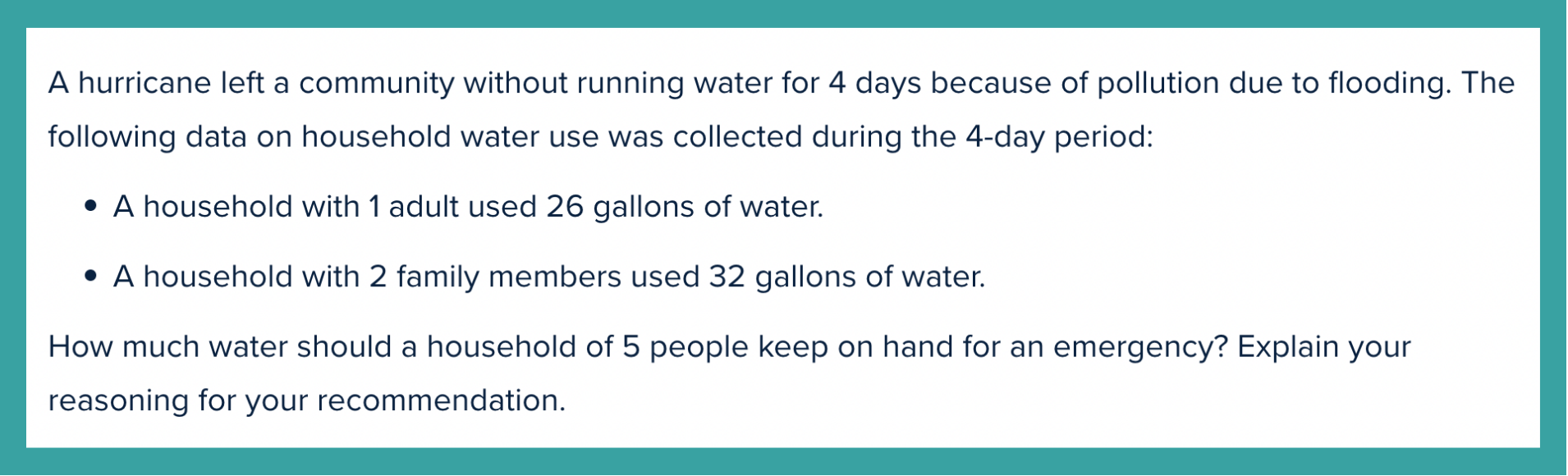
The design supports culturally responsive math teaching by:
-
Inviting personal reflection: Students can connect to lived or nearby experiences with storms, displacement, or community preparation, making the math more meaningful.
-
Encouraging student ownership: Students build shared understanding by questioning one another, discussing strategies, and testing different proportional approaches.
-
Valuing multiple ways of communicating: Drawings, ratios, tables, or verbal reasoning are all welcomed, affirming that communication in math can take many forms.
-
Connecting to justice: The context opens space to consider which communities are most impacted by natural disasters and how resources are allocated, linking math to real inequities.
-
Highlighting collective problem solving: Students see math as a communal tool for survival and fairness, not just an individual skill.
8th Grade CRMT Spotlight
This new Anchor Problem uses soap-making, an everyday and culturally rich practice, to explore linear relationships and proportionality. It draws on students’ funds of knowledge and affirms that math connects to real-life decisions, creativity, and community strengths.
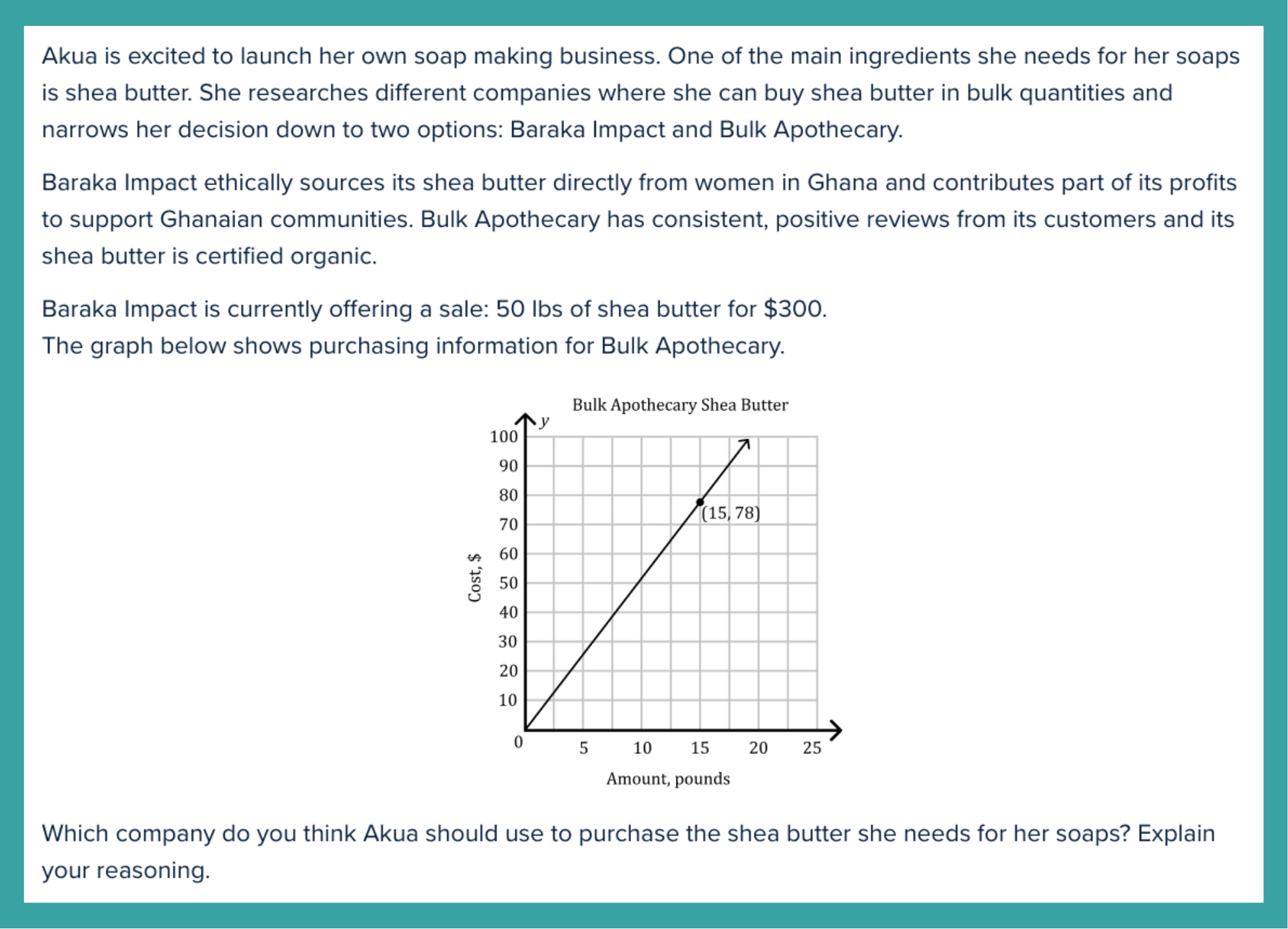
The design supports culturally responsive math teaching by:
-
Referencing funds of knowledge: Soap-making connects to home practices, family businesses, and cultural traditions, grounding abstract math in lived experiences.
-
Lifting up student language: Teachers can record and revoice language that students use (including home languages), positioning them as valid resources for mathematical thinking.
-
Affirming positive math identities: Multiple solution paths (tables, equations, graphs) are emphasized, and there isn’t a single “right” way to answer the questions, supporting flexibility in using math to model and reason about the world.
-
Inviting analysis of issues students connect to: Students might reflect on costs, sustainability, or small business economics, giving space for authentic critique.
-
Showcasing diverse thinking: Sharing and honoring varied approaches highlights the value of collaboration and inclusivity in mathematical problem solving.
Want to learn more about CRMT and how Fishtank Math can work in your school?
Schedule a demo of Fishtank Math at a time that works for you.
Not quite ready? Explore our comprehensive math curriculum.