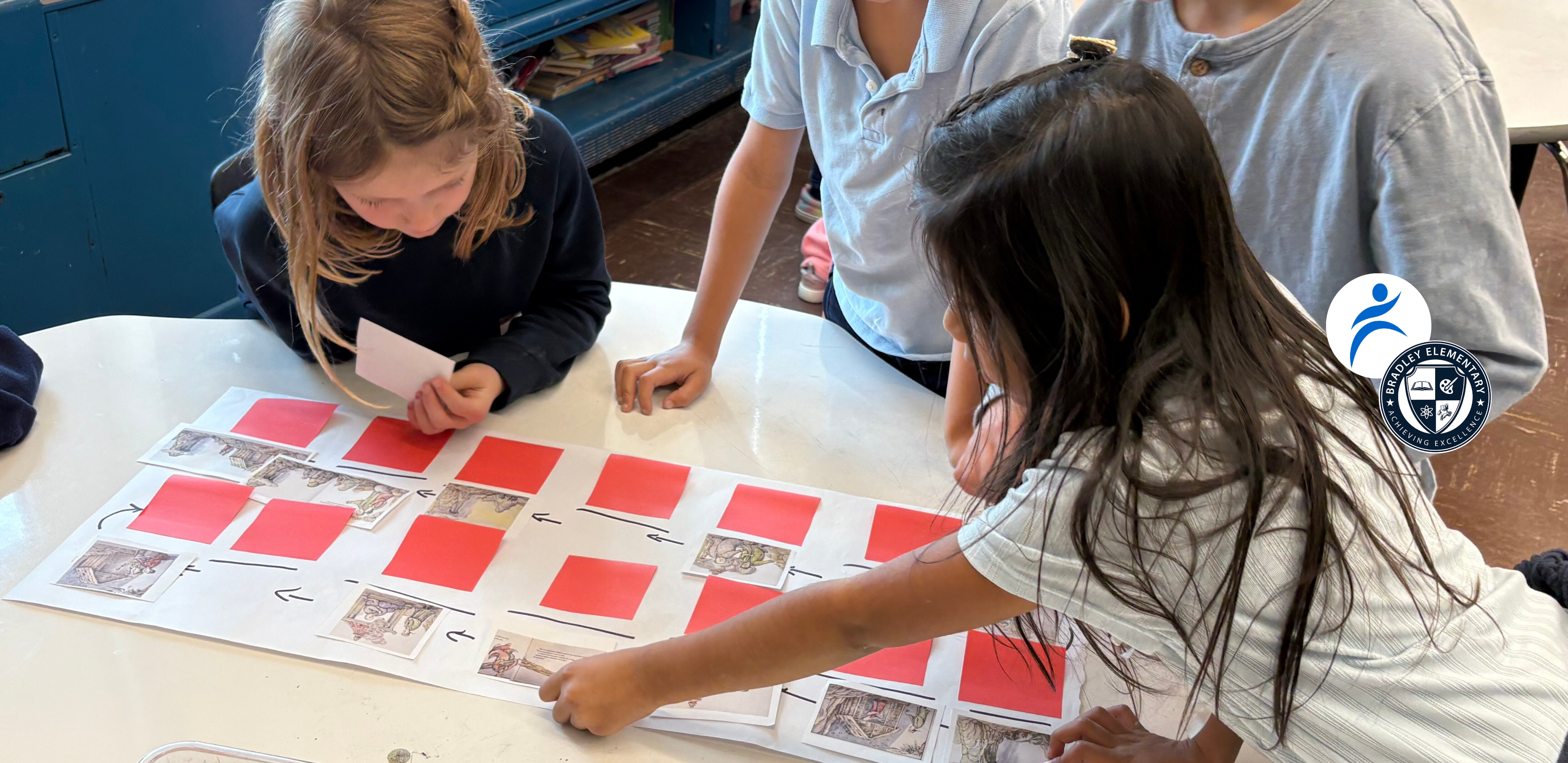
Fishtank School Spotlight: Bradley Elementary and Boston Public Schools
April 29, 2026
From 33rd to 84th Percentile: How Boston Schools Transformed Student Outcomes with Fishtank Learning
District Profile: Boston Public Schools
- Community: More than 46,000 students across 108 schools
- Student population: 81.6% of students served are considered ‘high needs’; the district serves significant populations of English Learners and historically underserved communities
School Profile: Bradley Elementary School
- Led by:
- Tommy Welch, Salem Public Schools Superintendent (former Boston Public Schools Superintendent, Region 1)
- Claire Carney, Boston Public Schools Superintendent, Region 1 (former Principal of Bradley Elementary School)
- Location: East Boston, Massachusetts
- Student population: 76% of students served are considered ‘high needs;’
- 29.5% English Learners; 44.2% First language not English
- 58.6% Low income
Challenge: Inconsistent instruction and low state accountability rankings (33rd percentile) due to fragmented curriculum adoption and inequitable performance across advanced and inclusion tracks.
Solution: Full adoption of Fishtank Learning ELA curriculum, coupled with targeted PD and a clear commitment to teacher empowerment.
Impact: Systemic performance improvement, including a jump to the 84th percentile for the pilot school, outperforming the rest of the district on key metrics, and eliminating separate advanced tracks in favor of a fully inclusive model.
Click the links for full profiles of Boston Public Schools and Bradley Elementary School provided by the Massachusetts Department of Elementary and Secondary Education (DESE).
 Located in East Boston, Massachusetts, Bradley Elementary School, along with multiple elementary schools across Boston Public Schools, serves diverse student populations, including significant numbers of English Learners and historically underserved communities. Then Regional Superintendent Tommy Welch** oversaw 720 teachers and 15 schools across the region, while Principal Claire Carney** led transformation efforts at Bradley School. In 2014, Bradley ranked in the 33rd percentile on state accountability measures despite operating both advanced and inclusion tracks—a fragmented approach that left many students without access to a rigorous English Language Arts (ELA) curriculum.
The Challenge: A System Struggling to Serve All Students
In 2015, Claire Carney looked at her school's state accountability ranking* and saw a troubling number: 33rd percentile. As principal of the Bradley School in East Boston, she knew they could do better. But the path forward wasn't clear.
The school operated two separate tracks—an advanced work class that attracted high-performing students from across the district, and inclusion classrooms serving students with disabilities and English Learners (ELs). The message was implicit but unmistakable: some students needed rigorous, engaging curriculum, and others needed something different.
“We had this mystery expectation,” Claire recalls. “If we didn't set an expectation of what high-quality writing looked like, students were in the dark about the goal and the exemplary product that they were working toward.”
Meanwhile, across the region, Tommy Welch faced a related challenge. As Regional Superintendent overseeing 720 teachers across 15 Boston elementary schools, he watched educators scramble to supplement the district-adopted ELA curriculum. One dual-language school was making more copies in September than most schools made in an entire year—pulling materials from online sources, translating them, and cobbling together their own curriculum.
"People were just doing their own supplemental materials because they weren't satisfied with what we had," Tommy explains. The result was inconsistent instruction, exhausted teachers, and students who weren't getting the engaging, culturally relevant texts they deserved. The lack of instructional coherence was preventing the region from closing its persistent achievement gaps.
The Breakthrough: When Quality Curriculum Meets All Students
The shift began when Claire's instructional coach, McKenzie Powers, started piloting Fishtank Learning in her inclusion classroom. That year, something remarkable happened: the inclusion class outperformed the advanced work class in writing.
For Tommy, the breakthrough was more personal. As both a regional superintendent and a parent with kids in Fishtank classrooms, he saw the transformation from multiple angles.
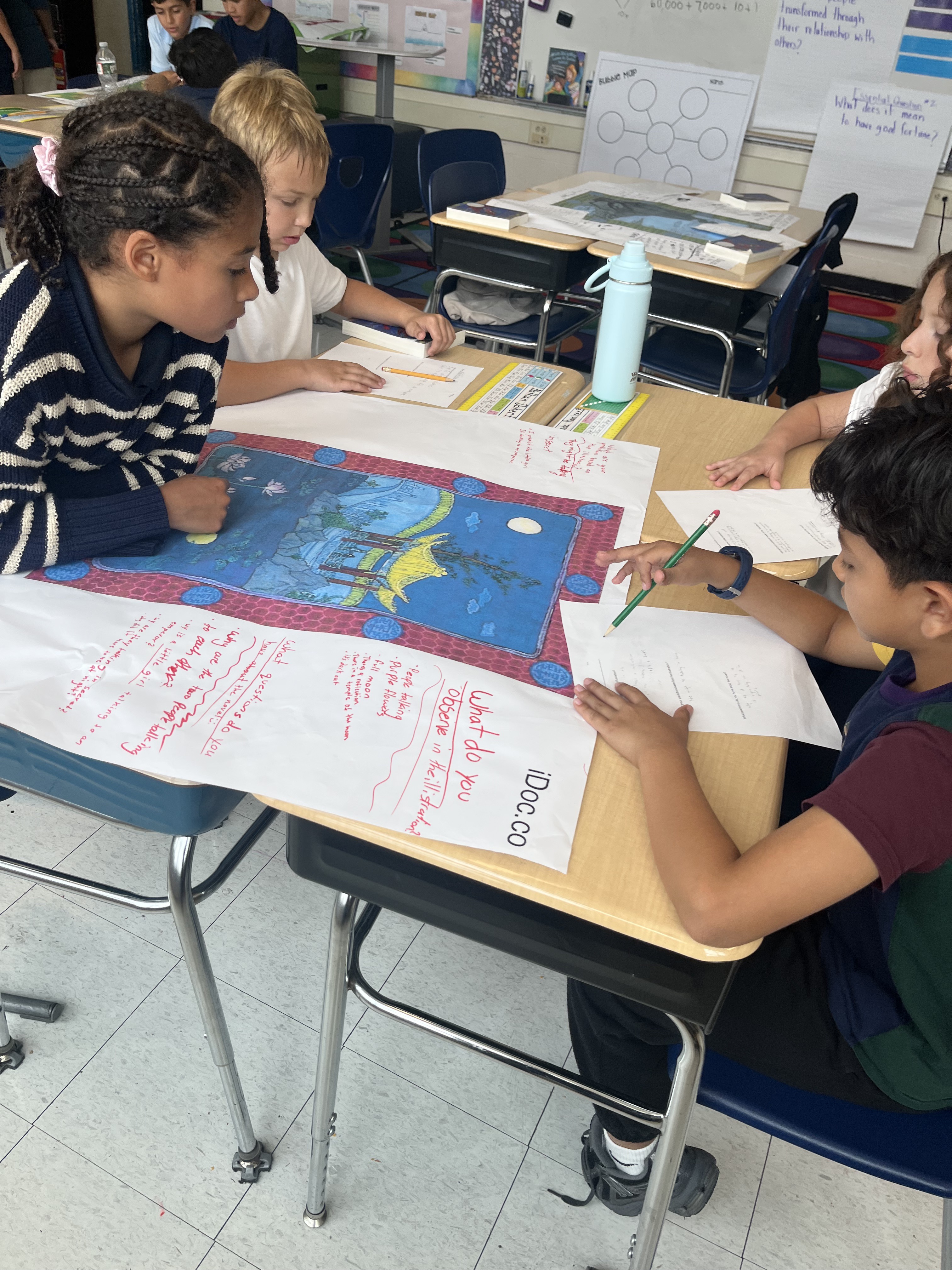
"I can walk into my kids' classroom anytime and they're sprawled all over the ground writing on posters together, doing pre-writes, discussing using the vocabulary of the story," he describes. "The teachers like it, too, because it's pushing the kids to be more independent."
One moment particularly stands out: visiting a school in the first week of the year with his Chief of Schools, they looked at students’ writing on the bulletin board. "Wait a minute, this is second-grade writing?" The elevated expectations were there from day one, and students were rising to meet them, demonstrating the power of rigorous curriculum.
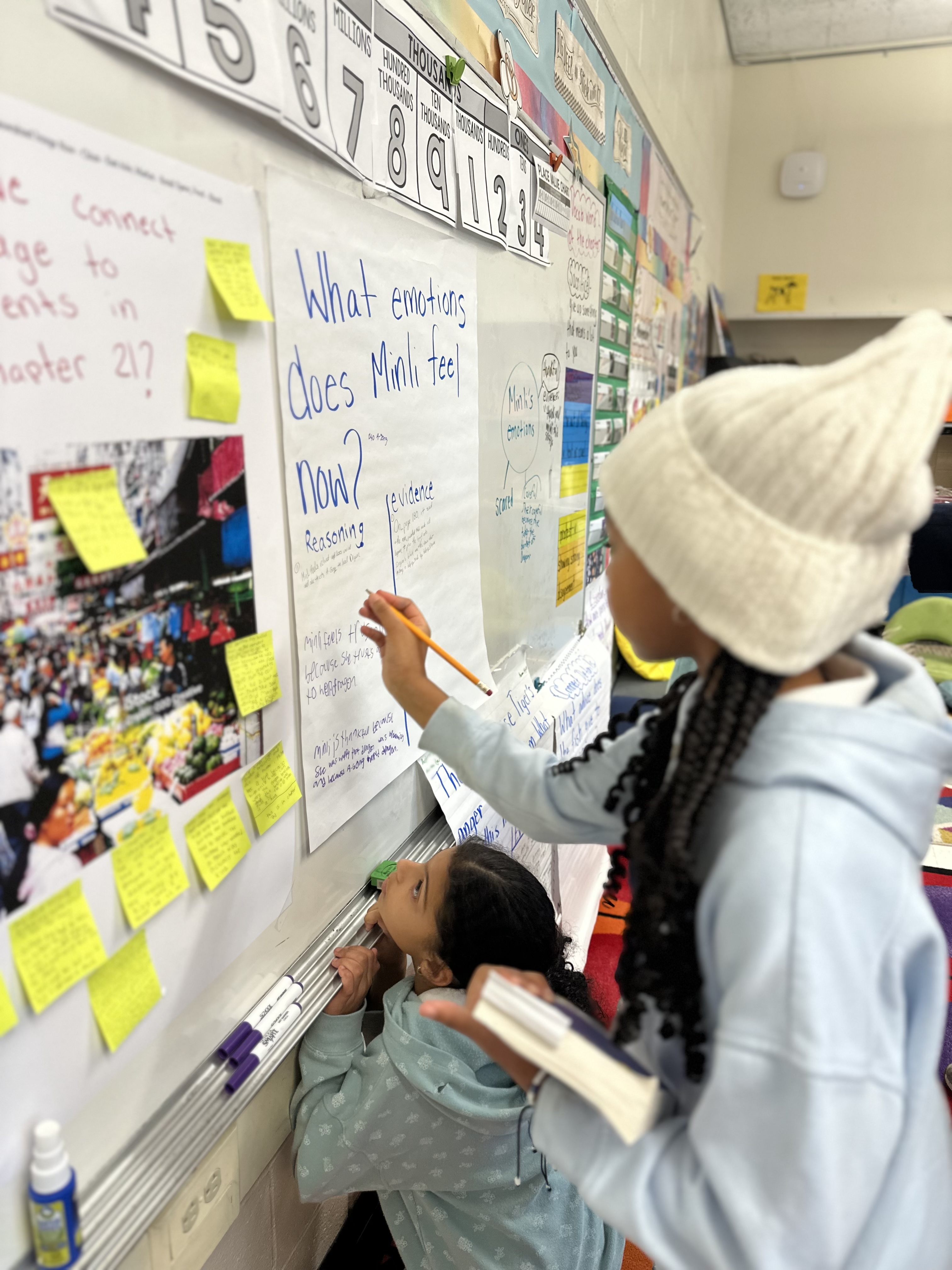
4th graders working through the ‘Finding Fortune: Where the Mountain Meets the Moon’ unit.
Courtesy of Claire Carney
Building the Foundation: Investment in Teachers
Both leaders understood that curriculum alone wasn't enough. Success required significant investment in teacher learning and collaboration—a core value shared with Fishtank.
Tommy directed nearly all of his ESSER funds—98% of the allocated budget—toward teacher stipends for planning and professional development. During February and April school breaks, he hosted opt-in PD sessions. Sixty to 100 teachers would show up voluntarily. At summer conferences, nearly 200 educators gathered to dive deeper into Fishtank units and share resources across schools.
He even contracted the Fishtank team to conduct thorough needs assessments with teachers and principals before designing customized professional development. "They did their homework and talked to everybody about what their needs were, and then we shaped this two-day PD." This process ensured the PD was directly relevant to implementation challenges teachers faced, reinforcing one of Fishtank's core values: We Trust Teachers.
Claire took a complementary approach at the Bradley School. She implemented learning walks where teachers observed each other's Fishtank instruction and provided feedback. She integrated Thinking Maps—a visual thinking strategy—with every Fishtank text and unit. And she embedded all ESL instruction directly into Fishtank lessons, leveraging the curriculum's vivid imagery and rich vocabulary to support language development.
"Our ESL teacher went through and thought about where every kid was with their ACCESS scores, what it would take to get them to the next level, and how we could leverage the Fishtank time to push students forward," Claire explains. The result? Seventy-three percent of their English learners met their language development targets, demonstrating the materials’ success as an integrated language acquisition tool.
The Stories That Show the Change
The transformation wasn't just visible in data—it was evident in daily school life.
At the Bradley School, the second-grade Cinderella unit culminates in something called the Bradley Ball. Students explore Cinderella tales from around the world, including versions from Morocco and Algeria that reflect their immigrant community. They prepare cultural foods, dress up, and host a dance party. "All the incoming second-grade parents, that's all they ask about: 'When is the Bradley Ball?'" Claire laughs.
In East Boston, where many families have immigration stories, first graders study inspiring artists and musicians—reading about Frida Kahlo, Diego Rivera, and others. The art teacher has students recreate works inspired by these artists. The music program takes kids to the Boston Pops. These examples show how the curriculum's texts serve as anchors for genuine, cross-curricular, and culturally relevant learning experiences.
Tommy arranged for 500 free tickets to an off-Broadway production of The Outsiders, perfectly timed with when sixth graders will finish the unit. "If I tell any museum or any theater, 'Hey, you're tied to our curriculum and the kids are going to walk in with real experiences of what you're presenting,' that's easy in a city like Boston."
Perhaps the most telling story comes from Tommy's observation of a sixth-grade teacher. "Her Outsiders book looks like a fan because she has so many post-it notes and annotations—it doesn't even close. She's reliving some of the titles that she read when she was a teenager, but with her sixth graders." Teachers weren't just delivering curriculum; they were genuinely engaged with the texts themselves.
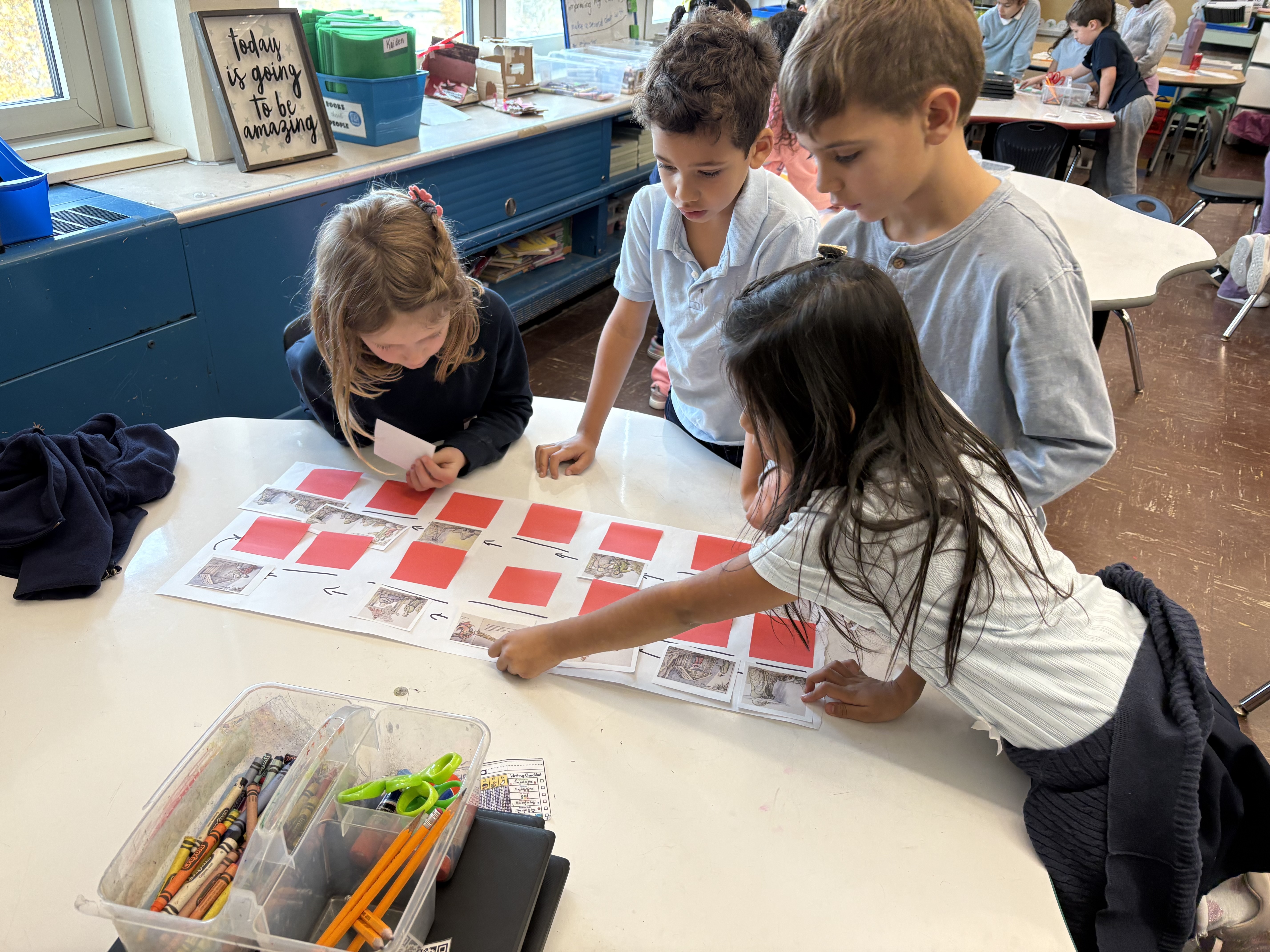
Courtesy of Claire Carney
Beyond Test Scores: The Ripple Effects
The measurable outcomes were impressive. Claire's school jumped from the 33rd percentile in 2014 to the 84th percentile by 2025. In 2024, the Massachusetts Department of Elementary and Secondary Education (DESE) honored the Bradley Elementary School as a National ESEA Distinguished School in the category of exceptional student achievement for excellence in serving special populations of students.
And, in November 2025, Bradley was designated the winner of the 20th EdVestors' "School on the Move" $100,000 prize in recognition of its significant student success and improvement over the years.
As a network of schools, Tommy's entire region consistently outperforms many schools in the Boston area on state testing, MAP growth assessments, and fluency measures. But he's equally proud of the improvements in attendance and school climate. "I attribute that to aspects of Fishtank because it's part of a very thoughtful program that these principals and teachers are putting together."
The impact extended beyond ELA. Claire noticed that transition phrases explicitly taught in Fishtank units started appearing in math explanations. "You can see how this strategy helps solve this, but I find it more efficient to use this other tool," students would explain—using sentence-level explanations that traditionally just didn't happen in math class.
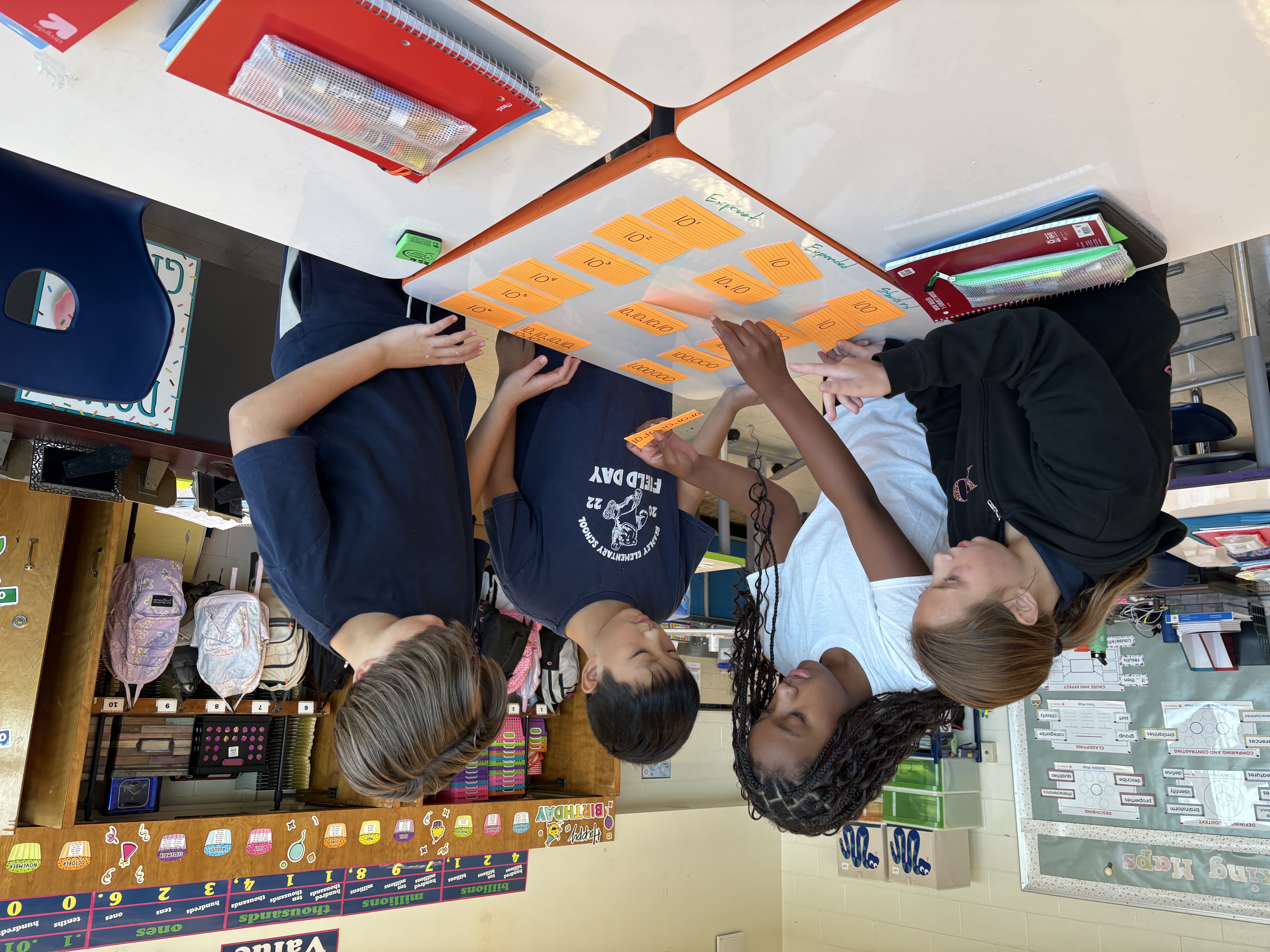
With the support of the district, the Bradley School phased out its advanced work strand (a.k.a. Gifted and Talented program) entirely, moving to a fully inclusive, double-stranded model where students with disabilities and ELs are proportionally represented across all classrooms with more peer models. The curriculum that was once considered only appropriate for "advanced" students was now successfully challenging and engaging every child. Living, breathing proof that believing in students leads them to do great things.
Courtesy of Claire Carney
A Culture of Continuous Improvement
What struck both leaders was how Fishtank fostered ongoing teacher collaboration and enthusiasm.
"If I walked out in the hall right now, I would see teachers gathered together talking about the next lesson," Claire says. "There's just constant conversation around that."
Tommy sees the same dynamic across his region. Third-grade teachers share resources with other third-grade teachers across schools. Fourth-grade teachers connect with their counterparts. Fifth- and sixth-grade teachers join professional learning opportunities at neighboring schools. When a new teacher joins a team, veteran teachers say, "This is what we did the last couple of years. What can you add to make it better?"
"I don't see anyone just rolling out the lesson plan folder that they did before," Tommy reflects. "You see the teachers diving into the lesson content and feeling more energized." That’s what happens when consistency meets teacher empowerment.
The reputation spread beyond Boston. Tommy estimates one school has hosted more than 20 visits from outside districts. He jokes that he's become "the unintentional spokesperson of Fishtank," constantly opening doors for educators from across the state and country to showcase the impact of HQIM on students and their teachers. "I've become the person everyone calls when they want to see this in action."
When a colleague from his leadership cohort mentioned she was bringing her team from New York City with the intention to visit Boston's top schools, Tommy did a quick count. Four schools on the itinerary, including Boston Latin—one of Massachusetts' highest-performing schools. Three of those four? His. All using Fishtank.
An Investment That Paid Off
Both leaders acknowledge that successful implementation required significant time and resources—resources they fought to secure because they believed in the investment.
"It's a heavy lift to get it going," Tommy admits. "It takes teachers to be in the right mindset. It takes principals to provide the space for not only professional development, but for them to actually wrestle with these new lessons or units or approaches. It takes time for people to digest that."
With limited discretionary professional development hours, how could educators be supported in rolling out this curriculum? His solution was creative: offer voluntary PD during school breaks, provide stipends, and give teachers space to experiment. "I told them to pick whatever unit you want. If you want to try The Real Story of Thanksgiving in March, who cares? Let's do it." Tommy notes, “Investing in building teacher capacity and providing time for teachers to collaboratively plan are key elements for a successful roll out of Fishtank.”
Given the results, adopting Fishtank Learning’s HQIM seems worth the implementation lift.
What Changed: Systemic Impact for More Than Just Scores
For Tommy, Fishtank validated an approach to leadership he'd always believed in: invest in teachers, trust them to collaborate, and give them tools worthy of their students.
"The data tells a clear story," he says simply. "We’re seeing consistent growth year after year." But beyond the data, he's seen a culture shift. Teachers are working together across schools. Students are doing the "heavy lifting" in lessons rather than teachers doing all the work.
Not only has Tommy seen the power of Fishtank Learning from the perspective of a district administrator, as a parent, he's watched his own children progress through Fishtank units—from kindergarten through sixth grade. "My sixth grader just finished The Watsons Go to Birmingham. I feel like I read that book twice. My son just finished Where the Mountain Meets the Moon. I'm on my second round with him because he's in fourth grade now." The level of engagement, the student writing output, the vocabulary they use at home—it's all changed. They are excited to finish the novels included in the units and engage in their class projects.
For Claire, Fishtank aligned with her deepest beliefs about education and equity. She thinks of Fishtank as "the roots" of everything else they do at the school.
"We shouldn't be hiding what quality looks like from kids," she reflects, returning to that early insight about "mystery expectations." "If there's some kind of magic key of what things should be, we shouldn't be hiding that from kids." Fishtank provides those exemplars: that clarity and that transparency about what students should strive for.
The transformation extended to teachers at every career stage. Veteran educators with 30-plus years of experience love the texts and engage enthusiastically. Younger teachers understand why the curriculum is high quality and feel empowered to make meaningful adaptations.
"One aha moment for me is how much teachers are talking about the texts they're reading and the lessons they're engaging with kids," Claire says. "Teachers are feeling empowered and enthusiastic about what they're doing, and it's leading to these great conversations."
Courtesy of Claire Carney
Looking Forward
Both school leaders continue to refine their practice. Claire is exploring the Writing Revolution framework to further strengthen writing instruction. Tommy continues to facilitate regional collaboration, connecting teachers across schools to share strategies and build on each other's innovations. And additional schools in BPS are taking notice of the work, with the dual-language school previously mentioned now considering a Fishtank pilot.
But the fundamental shift has already occurred. They've proven that all students—not just those in advanced tracks—can engage with rigorous, culturally relevant texts. They've shown that teacher collaboration and continuous improvement are possible even within systemic constraints. And they've demonstrated that investing in high-quality curriculum and teacher learning pays dividends that extend far beyond test scores.
It’s that continuous cycle of high expectations, clear models, teacher collaboration, and student engagement—that's what transformed these Boston schools from struggling to exemplary. And it all started with two fundamental beliefs: every student deserves access to the best curriculum available, and every teacher deserves the support to deliver it brilliantly.
_____
*This school's overall performance relative to other schools of the same school type (school percentiles: 1-99).
_____
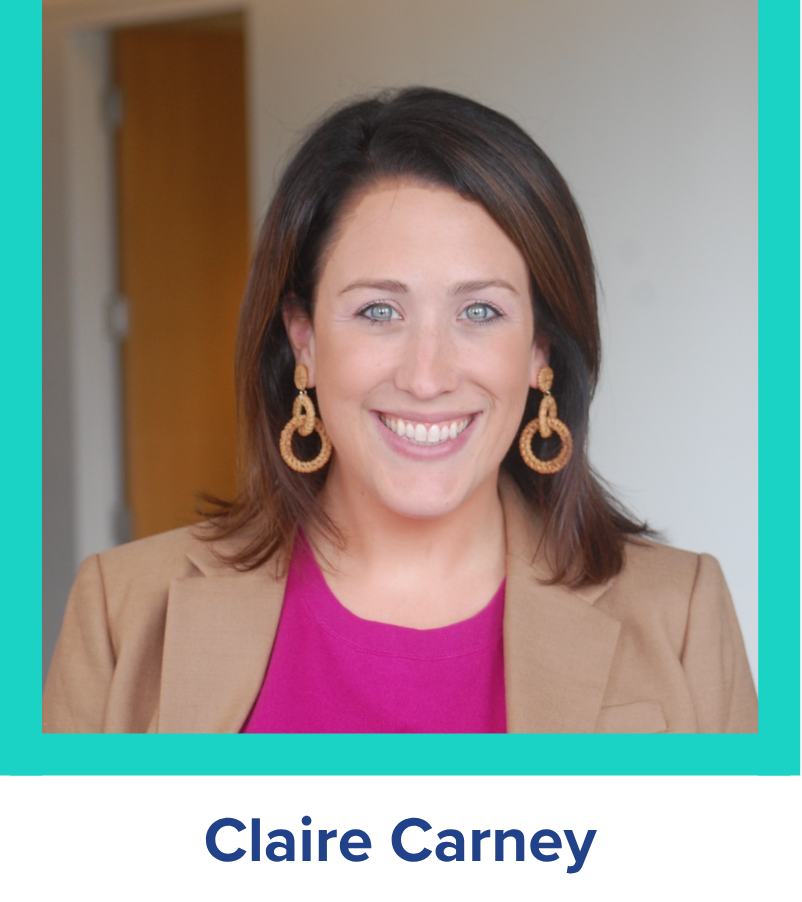
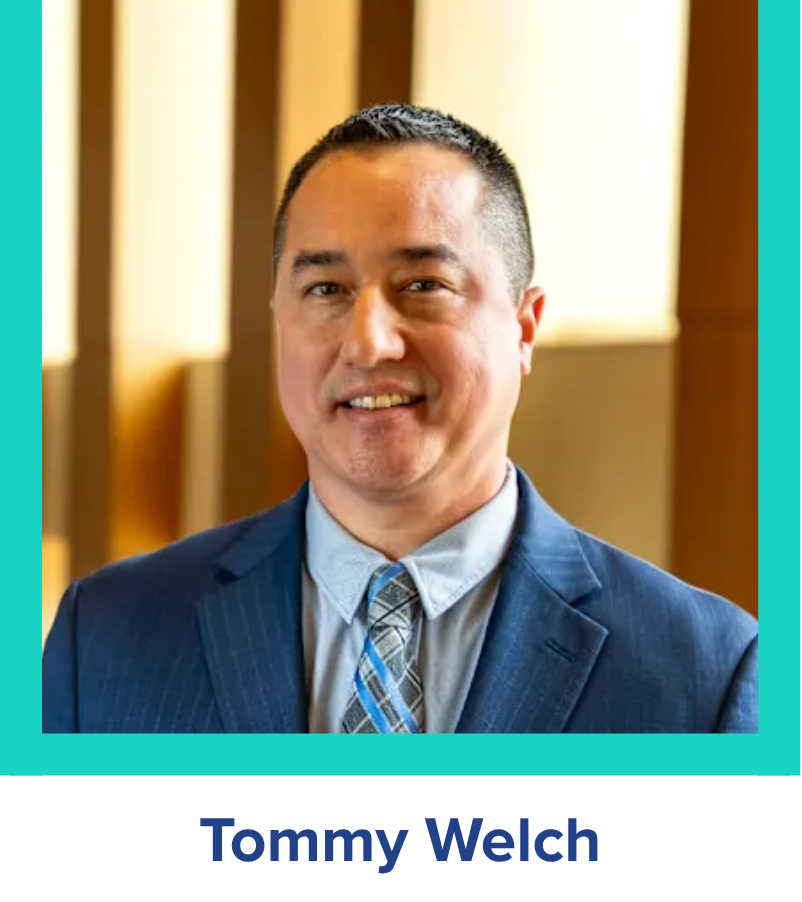
Many thanks to Tommy Welch and Claire Carney for sharing their experiences with Fishtank ELA.
Ready to talk about Fishtank ELA for your school or district? Start the conversation here.
Not quite ready? Explore thousands of high-quality K-12 lesson plans with a free Fishtank Learning account.
—
**Note: As of the 2026–2027 school year, Dr. Tommy Welch and Claire Carney have stepped into new leadership roles. Dr. Welch now serves as the Superintendent of Salem Public Schools, and Claire Carney serves as Regional School Superintendent for Boston Public Schools. Fishtank extends its warmest congratulations to both leaders as they continue serving Massachusetts students.

