view_context: Dynamic page
Adding and Subtracting Within 1,000
Students add and subtract within 1,000 using strategies based on place value, properties of operations, and the relationship between addition and subtraction. Students will explain why these strategies work and use them to solve one- and two-step word problems.
Math
Unit 5
2nd Grade
Unit Summary
In Unit 5, 2nd grade students build on their addition and subtraction work from adding and subtracting within 100 to add and subtract within 1,000. By the end of 2nd grade students are expected to have a plethora of strategies and generalizable methods in order to add and subtract three-digit numbers within 1,000 2.NBT.B.7 Add and subtract within 1000, using concrete models or drawings and strategies based on place value, properties of operations, and/or the relationship between addition and subtraction; relate the strategy to a written method. Understand that in adding or subtracting three-digit numbers, one adds or subtracts hundreds and hundreds, tens and tens, ones and ones; and sometimes it is necessary to compose or decompose tens or hundreds. , though they are not expected to fluently add and subtract within 1,000 until Grade 3, nor expected to be proficient with the standard algorithm until Grade 4. However, students will see methods that can generalize to larger numbers, like using expanded form to add and subtract, that will help them make sense of more abbreviated algorithms to come in later grades.
In Topic A, students begin the unit by adding and subtracting multiples of hundreds, tens, and ones in cases that do not involve composition or decompositions of units. Students first encounter an open number line here and use it as a tool both to record their work, as well as to help them decide whether to count up or back in order to subtract depending on their proximity.
Topic B focuses on methods for adding within 1,000. First, students connect and extend strategies like making tens to add within 100 to make tens or hundreds to add within 1,000 (e.g., e.g., 199 + 86 can be made into the easier computation 200 + 85). Next, students develop general methods to add, starting with using concrete base ten blocks to add by place, then drawing pictorial base ten blocks, and finally using more abstract methods like using expanded form to show how they solved. Throughout the topic, students analyze and critique others’ work as well as explain the strategies they used and why they work.
In Topic C, students focus on subtraction within 1,000. They start with connecting some of their strategies to subtract within 100 from Unit 1 to subtract within 1,000 (e.g., 397 - 99 can be made into the easier computation 398 - 100). Then, they similarly move through using concrete manipulatives to subtract by place, then pictorial, and finally more abstract methods like using expanded form to record their work. As with addition, students analyze and critique others’ work and explain their own strategies, as well as use the relationship between addition and subtraction to check their work.
Finally, in Topic E students build on their work with story problems by solving more difficult one-step story problems types as well as harder subtypes of two-step story problems. They build on their Unit 1 word problem work by continuing to use tape diagrams to represent the problem and using symbols to represent the unknown in their equations. They also use their knowledge of solving twice for two-step story problems from Units 3 and 4 2.OA.A.1 Use addition and subtraction within 100 to solve one- and two-step word problems involving situations of adding to, taking from, putting together, taking apart, and comparing, with unknowns in all positions, e.g., by using drawings and equations with a symbol for the unknown number to represent the problem. . By the end of second grade students should be proficient in two-step word problem combinations of two middle difficulty problem types with addition and subtraction.
The work students explore in this unit provides them with a better understanding of numbers and patterns first brought on in the foundation for their work in Unit 2. Students will continue to practice their fluency with 100 throughout their 2nd grade work as they continue to solve word problems within 100. Then in third grade, students will fluently add and subtract within 1,000 using algorithms, including the standard algorithm.
Fishtank Plus for Math
Unlock features to optimize your prep time, plan engaging lessons, and monitor student progress.
Assessment
The following assessments accompany Unit 5.
Mid-Unit
Have students complete the Mid-Unit Assessment after Lesson 10.
Post-Unit
Use the resources below to assess student understanding of the unit content and action plan for future units.
Use student data to drive instruction with an expanded suite of assessments. Unlock Mid-Unit Assessments and Answer Keys to help assess progress with unit content and inform your planning.
Unit Prep
Intellectual Prep
Intellectual Prep for All Units
- Read and annotate "Unit Summary" and "Essential Understandings" portion of the unit plan.
- Do all the Target Tasks and annotate them with the "Unit Summary" and "Essential Understandings" in mind.
- Take the Post-Unit Assessment.
Unit-Specific Intellectual Prep
-
Read pp. 58-61 on Number and Operation in Base Ten in the Progressions.
Essential Understandings
- Many strategies that can be used to make computations within 100 easier can be extended to make computations within 1,000 easier. For example, just like 46 + 29 can be thought of as 45 + 30, 426 + 299 can be thought of as 425 + 300.
- Three-digit numbers are composed of hundreds, tens, and ones, with 10 ones equivalent to 1 ten and 10 tens equivalent to 1 hundred. When adding and subtracting, one adds/subtracts like units, so hundreds with/from hundreds, tens with/from tens, and ones with/from ones. In addition situations, if there are 10 ones, they are composed to make a ten and if there are 10 tens, they are composed to make a hundred. In subtraction situations, if there are not enough ones to subtract, a ten can be decomposed into 10 ones and if there are not enough tens to subtract, a hundred can be decomposed into 10 tens.
- When subtracting, it is helpful to do all necessary decomposing first before any subtractions are carried out. This is because “when students alternate decomposing and subtracting like units, they may forget to decompose entirely or in a given column after they have just subtracted” (Progressions, p. 60).
- Students will eventually see that the standard algorithm is most efficient when performed from right to left, but for now students can operate from right to left or left to right. In fact, “many students prefer [working from left to right] because they read from left to right” (Progressions, p. 59).
- Because of the relationship between addition and subtraction, each operation can be used to check the other.
- Making sense of problems and persevering in solving them is an important practice when solving word problems. Key words do not always indicate the correct operation, so representing story problems with tape diagrams and equations helps students to conceptualize and solve them.
Materials
- Optional: Completed Blank Hundreds Chart to 1000 (1 per group) — From Unit 4 as a resource
- Base ten blocks (10 hundreds, 18 tens, 18 ones per student)
- Empty Number Line (1 per student) — These should be laminated or in sheet protectors to reuse
- Hundreds place value chart (1 per student) — These should be laminated or in sheet protectors to reuse
- Dry erase marker (1 per student)
- Sheet protectors (1 per student)
- Thousand Cube (Teacher only)
- Dice (1 per student) — Used in problem set
Vocabulary and Models
Models
| Model | Example |
| concrete base ten blocks | 475 shown in concrete base ten blocks |
| pictorial base ten blocks | 239 shown in pictorial base ten blocks |
| number line | Example: 545 + 30 |
| expanded form notation for addition | Example: 435 + 273 $$\begin{array}{crcrcrcc} &400&+ &30&+ &5 &&&\\ + \ \ \ &200&+ &70 &+ &3 &&&\\ \hline &600&+ &100&+ &8 &= &708\end{array}$$ |
| expanded form notation for subtraction | Example: 416 - 184 $$ \begin{array}{cccccccc} &\overset{300}{\cancel{400}} &+ &\overset{110}{\cancel{10}} &+ &6 &&&\\ - \ \ \ &100 &+ &80 &+ &4 &&&\\ \hline &200 &+ &30 &+ &2 &= &232 \end{array}$$ |
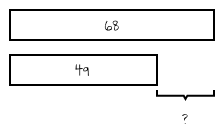
| tape diagram | Example: The second grade classes made greeting cards for some patients at a nursing home. Last week they made 68. This week they made 49. How many more cards did they make last week than this week? |



Unit Practice
Help students strengthen their application and fluency skills with daily word problem practice and content-aligned fluency activities.
Lesson Map
Topic A: Addition and Subtraction with Multiples of Hundreds, Tens, or Ones
Topic B: Addition within 1,000
Topic C: Subtraction within 1,000
Topic D: Story Problems
Common Core Standards
Key
Major Cluster
Supporting Cluster
Additional Cluster
Core Standards
Number and Operations in Base Ten
-
2.NBT.B.5 — Fluently add and subtract within 100 using strategies based on place value, properties of operations, and/or the relationship between addition and subtraction.
-
2.NBT.B.6 — Add up to four two-digit numbers using strategies based on place value and properties of operations.
-
2.NBT.B.7 — Add and subtract within 1000, using concrete models or drawings and strategies based on place value, properties of operations, and/or the relationship between addition and subtraction; relate the strategy to a written method. Understand that in adding or subtracting three-digit numbers, one adds or subtracts hundreds and hundreds, tens and tens, ones and ones; and sometimes it is necessary to compose or decompose tens or hundreds.
-
2.NBT.B.8 — Mentally add 10 or 100 to a given number 100—900, and mentally subtract 10 or 100 from a given number 100—900.
-
2.NBT.B.9 — Explain why addition and subtraction strategies work, using place value and the properties of operations. Explanations may be supported by drawings or objects.
Operations and Algebraic Thinking
-
2.OA.A.1 — Use addition and subtraction within 100 to solve one- and two-step word problems involving situations of adding to, taking from, putting together, taking apart, and comparing, with unknowns in all positions, e.g., by using drawings and equations with a symbol for the unknown number to represent the problem.
Foundational Standards
Number and Operations in Base Ten
-
1.NBT.B.2
-
1.NBT.C.4
-
1.NBT.C.5
-
1.NBT.C.6
-
2.NBT.A.1
-
2.NBT.A.2
-
2.NBT.B.5
Operations and Algebraic Thinking
-
1.OA.A.1
-
1.OA.B.4
-
1.OA.D.8
Future Standards
Number and Operations in Base Ten
-
3.NBT.A.2
-
4.NBT.B.4
Operations and Algebraic Thinking
-
3.OA.D.8
Standards for Mathematical Practice
-
CCSS.MATH.PRACTICE.MP1 — Make sense of problems and persevere in solving them.
-
CCSS.MATH.PRACTICE.MP2 — Reason abstractly and quantitatively.
-
CCSS.MATH.PRACTICE.MP3 — Construct viable arguments and critique the reasoning of others.
-
CCSS.MATH.PRACTICE.MP4 — Model with mathematics.
-
CCSS.MATH.PRACTICE.MP5 — Use appropriate tools strategically.
-
CCSS.MATH.PRACTICE.MP6 — Attend to precision.
-
CCSS.MATH.PRACTICE.MP7 — Look for and make use of structure.
-
CCSS.MATH.PRACTICE.MP8 — Look for and express regularity in repeated reasoning.