
A Unified Approach to Fishtank ELA Assessments
May 11, 2026
Assessments provide teachers with essential evidence about what students have learned, the specific challenges they’re facing, and how teachers might tailor their instruction to meet student needs in upcoming lessons or units.
Effective assessment tools provide practical, actionable insights that allow educators to adapt instruction and respond to data in real time. Over the last year, we’ve refined our tools based on feedback from our community of educators and the latest research in knowledge-building literacy instruction.
Beginning in the 2026-27 school year, Fishtank ELA (K-12) will feature a unified assessment system. This revised approach provides a consistent experience across the curriculum while empowering teachers with a clear understanding of student progress.
Missed the live event? Watch it here.
The Research Behind the Revisions
We started with the research. A 2026 analysis in The Reading League Journal on curriculum-embedded assessments suggests that effective measures should answer four essential questions:
- To what extent did students master the specific concept, skill, or text?
- Does student performance suggest that the instructional sequence or materials be adjusted?
- Is the current instructional approach effective for most students?
- What opportunities exist to extend or enrich instruction to maintain growth?
We’ve designed our assessments and teacher resources to help you answer these questions with confidence.
Beyond these four questions, we looked to the work of Susan Pimentel, lead author for the Common Core Standards for ELA literacy, and David Liben, educator and literacy expert. They’ve recently challenged the design of traditional assessments, arguing that they should more closely resemble daily instruction in a knowledge-building curriculum.
We agree: assessments shouldn’t feel like a departure from the lesson. Instead, they should measure how students navigate complex text, extract content knowledge, and use vocabulary within the context of standards-aligned questioning.
Putting the Research Into Action
The primary goal of our assessment system is to gauge how students are developing content knowledge while enabling you to monitor their proficiency with grade-level standards over time.
To meet that goal, we’ve made four major updates for the coming year:
1. Reframed Assessment Types
We’ve renamed and refocused our assessments to better reflect exactly what they measure and how they support your instruction.
2. Targeted Progress Monitoring
We’ve identified approximately five lessons per unit to use the Target Task as a ‘pulse-check’ on key content knowledge and core reading comprehension skills.
3. A Unified 6-12 Experience
We developed a brand new suite of high school assessments, aligning them with our middle school approach for a consistent transition through the secondary grades.
4. Streamlined Teacher Tools
We’ve redesigned all of our assessment resources—including answer keys, student materials, and scoring guides.
This also includes new rubrics and Teacher Tools, along with enhanced data dashboards to simplify your workflow in Fishtank Student.
A Closer Look at the Assessment Enhancements
Every Fishtank unit features a range of assessments designed to give you a clear picture of student learning.
Formative Assessments: Progress Monitoring
We’ve created a roadmap through each unit, identifying approximately five Target Tasks to use for formal progress monitoring. These tasks align with the unit’s core reading standards and key content understandings. To make these easy to identify, we’ve tagged these lessons with a progress monitoring icon on the unit summary page.
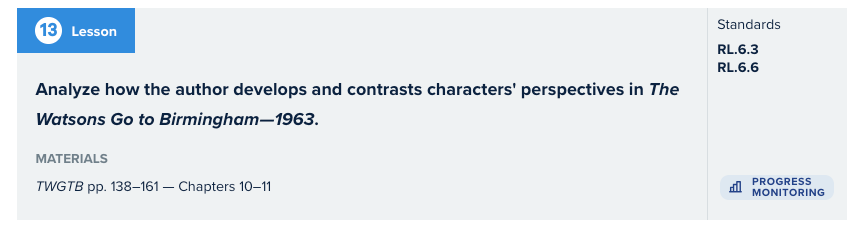
In grades 6-12, we’ve also identified Criteria for Success, key markers of a strong student response, to help you assess students' work.
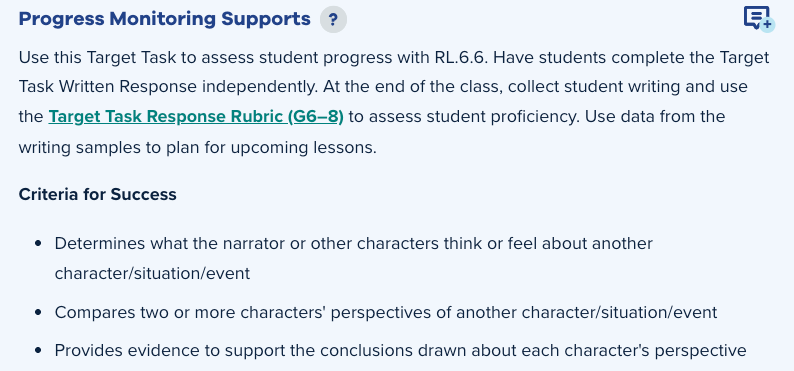
New Target Task Rubrics
Derived from our summative assessment written response rubrics, these tools help you parse out how students communicate their ideas—identifying specific strengths and challenges in a student-friendly format to support their continued growth.
Summative Assessments: Snapshots of Proficiency
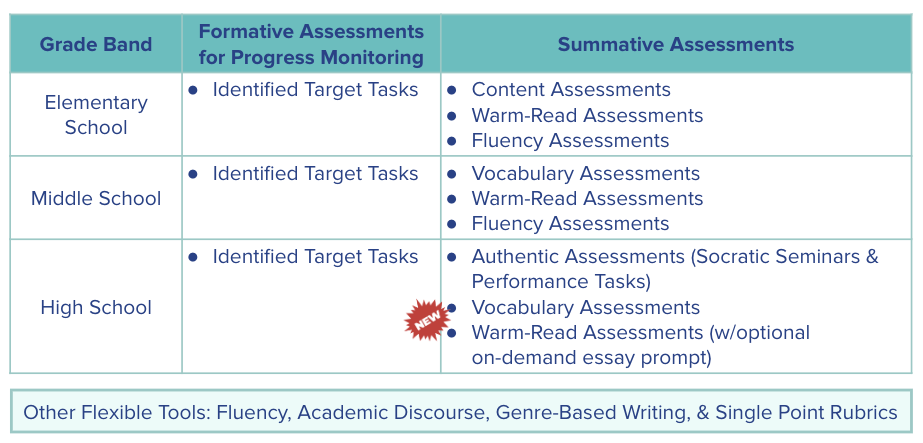
Each unit includes two types of summative assessments that measure proficiency on the specific content and standards taught.
Warm Read Assessments (Grades K–12)
Previously called “Cold Read Assessments,” we’ve renamed these Warm Reads because the passages students are asked to read are not completely new; they strongly align with the unit’s specific themes and content. This means students' comprehension of these new texts is supported by their existing background knowledge, and enables the assessment to truly assess students' application of key reading skills.
Every warm read assessment features at least three items per core unit standard, giving you deeper insights into student learning on the unit's core standards.
Content (Grades K-5) and Vocabulary (Grades 6-12) Assessments
These assessments measure a student’s acquisition of unit-specific knowledge and vocabulary.
High School Optional Assessments
We know traditional measures are important in some context, so we’ve built a new suite of optional assessments for high school that mimic our elementary and middle school approach. This includes an optional on-demand essay for each unit.
Refined Teacher Support and Scoring
We’ve updated our teacher-facing materials to take the guesswork out of data collection and scoring.
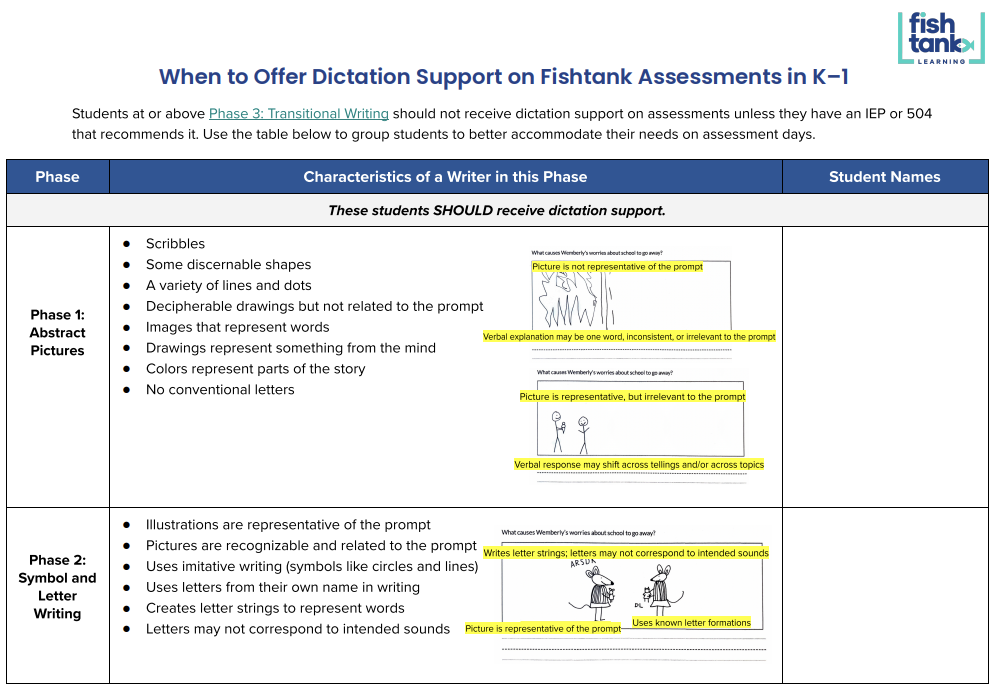
K-1 Administration Guidance
For our youngest learners, administration guidance is now side-by-side with scoring guidance. We’ve explicitly named where, when, and for whom to take dictation to streamline the process.
Simplified “Look Fors”
Scoring guidance now includes clear “Look Fors” grounded in the specific ideas and content students should include in their responses.
Aligned K-12 Rubrics
We use a consistent seven-point rubric for idea development and language conventions across all grades, from which our Target Task rubrics are derived, ensuring a unified experience as students progress.
Availability and Next Steps
The formative and summative assessments for Grades K-10 (Units 1-2) are live now. All remaining K-12 assessments are scheduled to be available by July 1.
We can’t wait for you to explore these enhancements and gain deeper insights into your students’ learning. If you have any questions, please visit our ELA page or contact your School Partnerships Manager.
FAQs
Q: There are several assessments. Do I need to give all of them?
A: No. Our goal is to provide the flexibility to measure what matters most for your students. For each grade band, we use our knowledge of students' developmental stages to denote recommended assessments. As a knowledge-building curriculum, we always prioritize the assessment that most accurately measures students' acquisition of content knowledge in each grade band. For instance, we prioritize the Content Assessment in elementary school, the Warm Read in middle school, and the Authentic Assessments in high school.
Q: How do I grade students using Fishtank Assessments?
A: Grading depends on your school’s/district’s specific requirements. Our Summative Assessments include answer keys with raw point values for each question to help inform your grading strategy.
For Progress Monitoring, we intentionally do not assign points, since we want to enable quick and efficient feedback. These rubrics are structured similarly to Single-Point Rubrics, making them easier for both teachers and students to use for feedback and growth.
Q: How often will you be updating the assessments?
A: Now that we've completed these revisions, we intend to keep assessments consistent to allow for year-over-year comparisons and growth data. We only make changes if an assessment isn’t performing as intended or if a licensing agreement requires a text change.
Q: How will I know when the new assessments are available or when they’re updated?
A: Your Updates document is the best place to track all changes and go-live dates. We’ll also place a note directly on the unit pages to alert you whenever a change has been made.

