
The Story Behind the Stories: How We Designed the New Grade 2 Fairy Tale Unit
August 17, 2026
Marnita Coenraad and Maggie Roth
The first unit of the school year sets the tone. It should captivate students from the very beginning while laying the foundation for the rigorous thinking and rich discussions that will define the year ahead.
So, why start with fairy tales?
Why Start the Year with Fairy Tales?
At first glance, stories about enchanted castles, devious wolves, and magical transformations can seem far removed from the lives of today's students. But fairy tales have endured for centuries for a reason. They continue to be retold because they speak to universal human experiences, and they have become part of our shared literary vocabulary.
Can you imagine watching Shrek (...and Shrek 2, Shrek the Third, Shrek Forever After, and the impending Shrek 5) without knowing Pinocchio, Snow White and the Seven Dwarfs, The Three Little Pigs, Little Red Riding Hood, Sleeping Beauty, Cinderella, The Gingerbread Man, and Puss in Boots? The humor, satire, and clever twists all rely on the audience recognizing the original stories.
Long after students leave second grade, they'll encounter references to the texts featured in both of Fishtank's Grade 2 Unit 1 options in other novels, films, advertisements, political cartoons, and everyday conversation. Authors assume readers know these stories. Understanding the original tales helps students recognize allusions, appreciate retellings, and notice when an author borrows from or challenges a familiar story.
Choosing the Stories that Shape the Unit
Traditional fairy tales reflect the values of the times and cultures in which they were told. Some of those messages continue to resonate today, while others invite discussion and reflection. But students cannot thoughtfully question or critique stories they don't know. By cultivating a deep understanding of these stories, we equip them not only to recognize them throughout their lives, but also to think critically about the choices authors make and the messages stories communicate.
When we began designing an additional unit option for Fishtank Learning's Grade 2 Unit 1, we knew we wanted to preserve students' opportunity to engage with the fairytale genre. The challenge was deciding which fairy tales would best encourage students to engage in the type of learning we envisioned. If fairy tales deserve a place at the beginning of second grade, the next question becomes: Which fairy tales, and in what sequence?
The new unit needed to lead students to the same key understandings and support the same rigorous reading standards, particularly RL.2.9, which asks students to compare and contrast different versions of the same story. Additionally, we wanted to create a coherent sequence of texts that would help students discover how fairy tales evolve across cultures and generations while remaining recognizably connected.
With those goals in mind, we turned to the most challenging part of the project: selecting the texts. Two ideas guided our text selection decisions. First, we wanted students to recognize the structures and patterns that make a fairy tale a fairy tale and use that understanding to compare familiar stories. Second, we wanted students to think about authors as decision-makers, asking how and why fairy tales change across settings, cultures, perspectives, and audiences.
Ultimately, every text needed to earn its place. Each one needed to contribute something unique to students' understanding of the genre and to the learning progression across the unit.
When the Perfect Text Doesn't Exist
My text selection journey began, as it so often does, at the local library, and my initial thought was "Wow, we need to update our fairy tale selection." Little did I know how accurately the worn covers in the sparse 398.2 section represented the availability of fairy tales. Scanning the familiar titles, flooded with nostalgia, I settled in, surrounded by Beauty and the Beast, Rumpelstiltskin, Rapunzel, Little Red Riding Hood, and more, penned and illustrated by familiar authors and illustrators like Jan Brett, Mac Barnett, Rachel Isadora, and Jerry Pinkney.
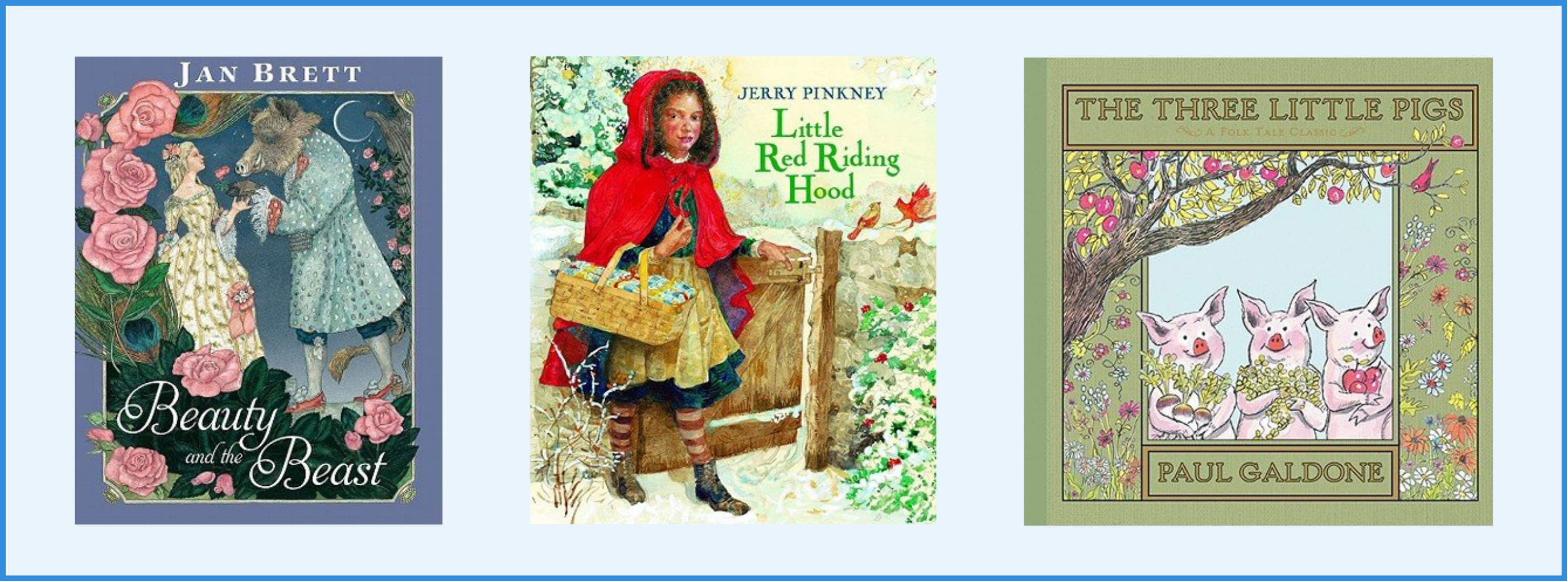
At the heart of this unit are three core fairy tales: Beauty and the Beast, Little Red Riding Hood, and The Three Little Pigs. Around each of those anchor texts, we wanted students to compare an authentic cultural variant and, eventually, a fractured retelling. In the first part of the unit, the core stories introduce the defining characteristics of fairy tales, giving students a foundation for recognizing patterns across the genre.
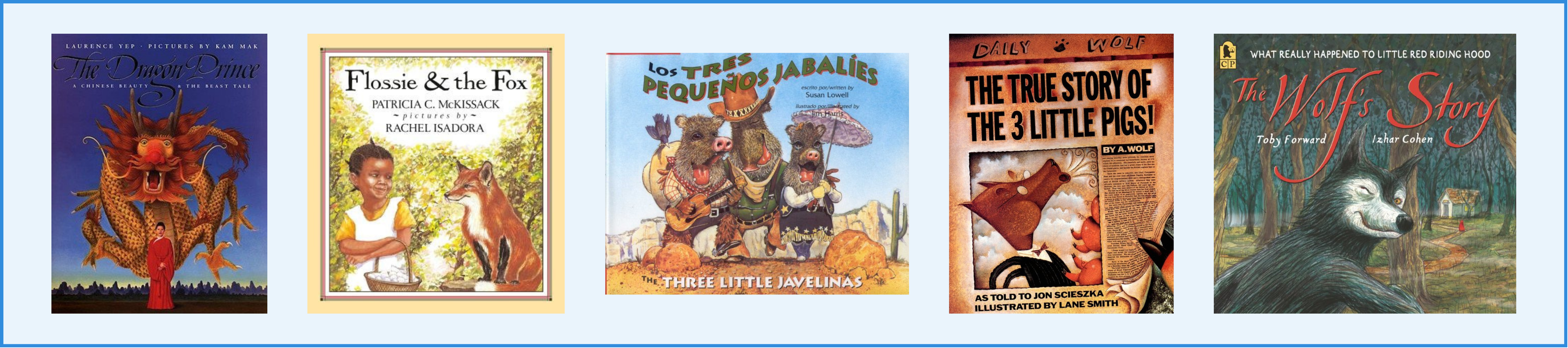
In the second part, The Dragon Prince, Flossie and the Fox, and The Three Little Javelinas invite comparison by presenting familiar stories in new cultural settings. The final, What Really Happened to Little Red Riding Hood: The Wolf's Story and The True Story of the Three Little Pigs, encourage students to examine why authors reinterpret well-known tales, helping them recognize that stories evolve as they move across time, place, and audience.
On paper, curating these text sets sounded straightforward. It wasn't.
Take Rumpelstiltskin. This was, perhaps, the set of texts I was most excited about! We settled on a version by Paul O. Zelinsky, which has rigorous text and rich illustrations for students to analyze. We considered a newer printing by Mac Barnett; however, it includes some anachronisms. A natural pairing for this was Virginia Hamilton's The Girl Who Spun Gold, a retelling set in the West Indies. This authentic multicultural version is rich with details for students to notice that while cultures tell stories in unique ways, many fairy tales share recognizable structures and themes across time and place. It had the added bonus of nicely mirroring the inclusion of Cendrillion: A Caribbean Cinderella in Grade 2 Unit 1. Finally, the third book in this set was the fractured fairytale, Rumpelstiltskin's Daughter by Diane Stanley. This reimagining invites students to notice how authors can intentionally play with familiar stories to comment on and critique aspects of the story they do not agree with or are no longer aligned with our collective values.
So, why isn't Rumpelstiltskin one of the core fairy tales? Two-thirds of those titles are out of print. After scouring libraries, bookstores, and the internet for ATU 500 "Name of the Helper" stories and coming up empty-handed, I cut it loose.
This scenario repeated itself over and over as we balanced the aforementioned considerations with seeking out stories that celebrated bravery, cleverness, perseverance, kindness, and community alongside the more familiar "prince and princess" narratives. The result is more than a collection of engaging fairy tales. It's a carefully sequenced set of texts that allows students to revisit ideas, refine their thinking, and deepen their understanding with each new story.
Bringing These Stories Into Your Classroom
Fairy tales have endured for centuries because each generation has found new ways to tell them. We hope that this unit serves as both a foundation and an invitation. Once students understand the structures and patterns of fairy tales, continue expanding your collections with stories that reflect the cultures, languages, and experiences represented in your own classrooms. Invite students to share stories from their families and communities. Seek out retellings from around the world…or better yet, have your students write them! Every new fairy tale becomes another opportunity for students to make connections, notice patterns, recognize both what changes and what stays the same, and discover that stories belong to all of us.
—
Preview Fishtank ELA’s Grade 2 Unit 1 when you register for a free Fishtank Learning account.
 Marnita Coenraad
Curriculum Writer, ELA K-5
Marnita is an ES ELA Curriculum Writer for Fishtank Learning. She taught elementary school for 13 years in Texas and Alaska before working as the Program Specialist for the Raven Writes program at Sealaska Heritage Institute. She is a National Board Certified Teacher with a bachelor's degree in Philosophy from Creighton University and master’s degrees in Reading and Writing Instruction from Southern Methodist University and in Curriculum Studies from the University of Hawai‘i at Mānoa.
 Maggie Roth
Senior Curriculum Director, ELA K-5
Maggie is the Senior ELA Curriculum Director for grades K-5 at Fishtank Learning. Maggie joined the Fishtank team after a decade teaching 1st, 2nd, and 5th grades in public and charter schools in Providence, Brooklyn, and Boston. She has also worked as an Instructional Coach with the Sposato Graduate School of Education, an EdVestors Zeroing in on Math Teaching Fellow, and as the Director of High School Placement at CitySquash. She holds a Bachelor’s degree from Amherst College and a Master of Arts in Teaching from Brown University.
Create an Account


Stay Up to Date
Register for a free Fishtank account and stay up to date with the latest resources and guidance to be your most effective in the classroom.