
8 Intentional Ways to Bring More Joy to Your Math Class
July 29, 2026
Meg Hearn
Every student deserves the chance to fall in love with mathematics.
That doesn't happen because every lesson is entertaining. It happens when students experience the wonder of discovering patterns, the satisfaction of solving a challenging problem, and the confidence that comes from knowing their ideas matter.
NCTM describes joy as an essential part of mathematics learning because it helps students build understanding, develop positive mathematical identities, and make connections to the world around them. Joy isn't separate from rigorous mathematics. It is one of the reasons students want to keep doing mathematics.
At Fishtank Learning, our math team is committed to bringing joyful math experiences to all. Here are eight ways to intentionally create more of those moments in your classroom.
1. Invite Students to Move
Math can (and does) happen away from students’ desks.
When students stand, sort, build, walk, gesture, or physically model mathematical ideas, they engage more of their thinking. A quick gallery walk, human number line, geometry scavenger hunt, or partner movement routine can bring fresh energy to a lesson while helping concepts stick.
Movement reminds students that learning is something they do, not just something they watch.
2. Make Room for Play
Play belongs in every grade level.
Whether students are exploring patterns, solving puzzles, testing strategies in games, or wondering "What happens if...?", playful experiences encourage curiosity and perseverance. Students become more willing to take risks because the goal shifts from getting the answer quickly to exploring possibilities.
Play doesn't lower expectations. It creates conditions where students are more willing to think deeply.
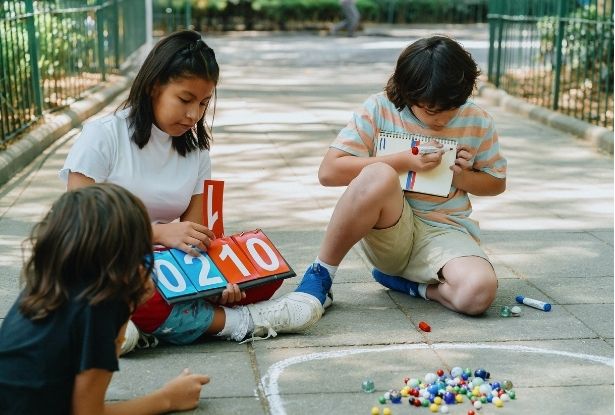
3. Help Students See Math Everywhere
Mathematics lives far beyond the classroom walls.
Invite students to notice math in music, art, architecture, nature, sports, or community spaces. Explore symmetry in local buildings, rhythms in music, or patterns in cultural art forms. These connections help students recognize mathematics as a way of understanding the world, not simply a school subject.
When students see math in the world around them, it becomes more meaningful and memorable.
4. Engage All the Senses
The more ways students experience mathematics, the more opportunities they have to make sense of it.
Use color to highlight patterns. Build with manipulatives. Count with rhythm. Draw diagrams. Fold paper. Create models. Encourage students to explain what they notice and wonder out loud.
These experiences help abstract ideas become tangible and give every learner multiple ways to engage.
5. Create a Classroom That Talks Math
Joy grows in community.
Students deserve opportunities to explain their thinking, challenge ideas respectfully, and learn from one another. Rich mathematical conversations help students discover that there are often multiple strategies, multiple perspectives, and new questions worth exploring.
Some of the best discussion prompts are problems that:
- Have more than one reasonable approach.
- Invite students to make predictions.
- Encourage noticing and wondering.
- Leave room for interpretation before formalizing ideas.
These conversations help students see themselves as valued contributors to the mathematical community.

6. Celebrate Students' Mathematical Identities
Every student brings mathematical strengths into the classroom.
Help students recognize those strengths by creating opportunities to share who they are as mathematicians. At the beginning of the year, students might write about their hopes for math, create a "favorite number" challenge for classmates, or develop a Top 10 list of lessons they wish younger students knew before entering the grade.
These simple routines communicate an important message: Your experiences and ideas matter here.
7. Build with Low Floor, High Ceiling Tasks
The most worthwhile tasks invite everyone in.
Choose tasks that allow every student to begin while offering opportunities for deeper thinking and extension. When students experience early success, continue stretching their thinking and reasoning by asking them what patterns they notice, what connections they see, and how they justify their ideas.
When every learner has an entry point, participation grows, confidence builds, and classrooms become places where students have agency and engage in productive struggle rather than counterproductive struggle.
8. Celebrate Curiosity, Not Speed
Joy grows when students know they have time to wonder, reason, and think deeply.
Celebrate thoughtful questions, creative strategies, careful reasoning, and moments of discovery. Pause when a student notices an unexpected pattern. Ask classmates to build on one another's ideas. Highlight perseverance alongside correct answers.
Students begin to understand that mathematics is not simply about finding answers. It is about making sense of ideas.
Joy Is Built One Lesson at a Time
Students will not remember every worksheet they completed. They will remember the lesson that makes them feel something, the conversation that changes their thinking, the pattern they discover, or the moment they realize they could solve a problem they once thought was really difficult.
Creating joyful math experiences begins with small, intentional choices that invite students to move, wonder, create, discuss, and see themselves as capable mathematicians.
When joy becomes part of the design of mathematics instruction, curiosity grows, confidence follows, and every student realizes more opportunities to experience the beauty of mathematical thinking.
What's one small change you’re planning so your students experience more joy in mathematics?
—
Looking for more ideas? Explore Fishtank Math for lessons that spark curiosity, encourage meaningful discourse, and help students see themselves as confident mathematicians.
 Meg Hearn
Co-Managing Director, Math
Related Blog Posts
10 Tips for a Strong Start to the School Year with Fishtank ELA
Ready for back-to-school? Discover 10 practical tips and tools to internalize lessons, build community, and start strong with Fishtank ELA this year.
Create an Account


Stay Up to Date
Register for a free Fishtank account and stay up to date with the latest resources and guidance to be your most effective in the classroom.