Fishtank School Spotlight: Oakland Unified School District
August 06, 2026
Equity and Rigor through HQIM: How Oakland Unified's Move to Fishtank ELA is Yielding Results
District Profile: Oakland Unified School District
-
Location: Oakland, California
-
Project Leads:
-
Jeannie Bruland, Secondary Literacy Coordinator
-
Michelle Espino, Secondary Literacy Coordinator, a former Oakland Unified English teacher, department chair, and high school administrator
-
Elizabeth (Lizzie) Brownson Humphries, Literacy Coordinator
-
-
Community: 33,916 TK–12 students across 82 district-run schools and programs, including 17 high schools serving 9,424 students in grades 9–12
-
Student population:
-
81.7% eligible for free or reduced-price lunch
-
32.2% English Language Learners; 49.4% speak a language other than English at home, with at least 72 languages spoken
-
16.9% receive special education services
-
3,100 newcomer students enrolled in 2024–25
-
-
Fishtank ELA adoption: Grades 9–12 across all 17 high schools, beginning in the 2023–2024 school year
Challenge: A 20-year gap since the last high school ELA curriculum update left an estimated 97% of teachers building their own materials, resulting in dramatically uneven expectations across classrooms, a gap that students themselves had begun to identify and ask the district to address.
Solution: Full adoption of Fishtank Learning ELA across grades 9–12 at all 17 high schools, prioritizing grade-level rigor, student-to-student talk, culturally relevant texts, and teacher autonomy.
Impact (in progress): A shared instructional foundation across all 17 high schools for the first time in two decades, early classroom evidence of deeper academic discourse and student self-reflection, and the emergence of a more collaborative ELA teacher community across the district.
 Located in the San Francisco Bay Area, the Oakland Unified School District (OUSD) serves a diverse community of nearly 34,000 students across 82 district-run schools and programs, including 17 high schools. In 2023, after evaluating more than 20 ELA programs and running an in-classroom pilot of three finalists, OUSD's secondary literacy team launched a district-wide implementation of Fishtank ELA across all 17 high schools, the district's first common high school ELA adoption in nearly 20 years. Leading the effort are Jeannie Bruland, Secondary Literacy Coordinator, Michelle Espino, a former Oakland teacher and administrator now serving as Secondary Literacy Coordinator, and Lizzie Brownson Humphries, the district's Literacy Coordinator.
The Challenge: When 97% of Teachers Are Writing Their Own Curriculum
Since that most recent curriculum adoption nearly 20 years ago, Oakland's high school ELA teachers had been working largely on their own. The district's official textbook predated the Common Core. Many of its stories no longer reflected the students sitting in Oakland classrooms.
"My colleague Jeannie Bruland and I surveyed people," Lizzie explains. "About 97% of our teachers were creating their own curriculum, which is incredibly labor-intensive, as we know."
Without a shared foundation, expectations diverged, sometimes dramatically, between classrooms in the same building. "You might take an ELA 1 class with one teacher and be expected to read four books, produce X number of essays," Lizzie recalls. "And then if you were in a classroom down the hall, in the same school, maybe you read only one book in a semester and your writing expectations are really different."
For Michelle, who taught English in Oakland for 14 years before moving into instructional leadership, the deeper problem was that there was nothing to calibrate against. "We knew there needed to be more rigor. We knew we needed to teach grade-level text," she says. "But there was no guidance and no bar set. So people were independently making those decisions but without any checks and balances around it."
What made the equity case impossible to ignore? The students.
OUSD's All City Council, a district-wide student leadership body, brought the inequity to leaders directly. "They [the students] talk to each other," Lizzie says. "So they know that down the road at another school, students are being asked to write this many pages, or they're being taught how to format an essay. And they understand if they're not being asked to do that, expectations for them are different."
And the students who had already graduated had something to say, too. The most powerful evidence came from Oakland graduates returning home from college.
"What kids were consistently coming back and saying," Michelle remembers, "was 'I needed more reading support. I needed to be reading higher-level texts, because now that I'm in college, I don't understand what's going on and I don't have the strategies to navigate those things.'"
Many were hitting a wall in their sophomore year of college. "We could get them into college, we could get them to pass that A-level exam and do those entrance essays," Michelle continues. "But once kids got through their sophomore year—that rigor that happens in university between sophomore and junior year—they couldn't [bridge] that gap."
Michelle's summary of the pattern is one Oakland leaders now return to often:
"You practice how you want to play. If you're always doing third- and fifth-grade-level work, then that's how we play."

The Selection: From 20 Programs to a District-Wide Bet on Fishtank
Determined to find materials that would establish a baseline of quality without scripting away teacher craft, the OUSD team began with a field of more than 20 ELA programs. They narrowed it to three finalists, then ran an in-classroom pilot of all three across multiple high schools—gathering feedback from both teachers and students through empathy interviews along the way.
A few things separated Fishtank from the alternatives.
Genuine Academic Discourse
One of the finalists was heavily technology-based, with built-in scaffolds, read-aloud features, and interactive lesson progression. But with Fishtank, students were “talking more”—engaging in authentic academic discourse—and they liked doing so.
"You could essentially put a student on a computer and move them through a lesson," Lizzie recalls. "But in the Fishtank classroom, students were actually talking to each other. And when we talked to students about that, they preferred it. They preferred it over being on a computer all day."
Coming out of the pandemic, that mattered. "Our classrooms were a lot quieter coming back from virtual school than they had been prior," Lizzie says. "It just felt like the Fishtank materials were going to do a better job of getting students and adults actually engaging with each other around big ideas and around the text. A little more human, in general."
Building Connection and Deeper Knowledge
The texts created real conversations. Both Michelle and Lizzie pointed to the strength of Fishtank's essential questions and the arc those questions form across four years of high school ELA, moving from questions about self to questions about the larger world and society.
"We thought there seemed to actually be some connection, this idea of going from self to larger world and society, with high-quality essential questions that felt engaging to kids and validating to what people were already teaching and wanted kids to get," Michelle says.
Particularly powerful: Fishtank's pairing of canonical texts with contemporary ones, including many by authors of color. "When there was more sort of canonical text, the curriculum designers were pairing it with something a little more contemporary," Lizzie says. "Oftentimes putting text in conversation, even critiquing some of the more familiar traditional ELA texts. That was cool."
Helping Teachers Grow
Teachers wanted to be challenged, too.
During the pilot, teachers reported back something Michelle's team didn't expect to hear so consistently: Fishtank raises the bar for students and teachers alike. And that's worth it.
Certainly, the built-in scaffolds of the tech-based option would have been useful: Oakland has a substantial English Learner population, a significant special education population, and many students reading below grade level. But Lizzie’s team worried that those built-in scaffolds would take some of the craft out of teaching.
"It felt like it was going to take some of the craft out of teaching, and shift the experience in a way that was a lot less engaging and a lot less interesting for both the adults and the students involved," Lizzie reflects.
Honoring What Teachers Built, While Building Something New
Both Michelle and Lizzie are clear about one thing: Oakland's teachers were not the problem. They had been doing extraordinary work in difficult circumstances.
"Our Oakland teachers are amazing," Lizzie says. "Everyone is out there trying to do their best. All the curriculum you [teachers] were designing—you were doing your best to try to hone something you thought was going to serve your students."
That conviction shaped how OUSD approached the adoption. Rather than positioning Fishtank as a replacement for teachers' work, the team framed it as a foundation that would let teachers build something stronger together.
"What are our students asking of us in terms of common experiences? And then what's the potential if we were to create stronger collaborative relationships across our ELA community? You taught that unit too. How did you support your English Learners? It's about creating a lot more opportunities for some of the things that are working to spread," Lizzie says.
The early signs of that collaboration are already showing. Because Fishtank's emphasis on Socratic seminars and student-to-student talk has created a shared focus across schools, OUSD teachers have begun networking across buildings to share strategies, like how to launch a seminar, how to track student participation, and how to get past the awkward first attempt.
"We see teachers taking up each other's materials super fast in a way that we wouldn't have seen if we weren't trying to engage students in the same discussion," Lizzie says. Michelle adds her own commitment to teacher autonomy: "I trust Oakland teachers in many ways to provide relevance to our young people. So [Fishtank] felt familiar and felt valuing and honoring of the work that had already been done."
She's also quick to credit the curriculum's particular strengths for newer teachers: the text-dependent questions, the level of analysis built into each unit, and the way Fishtank's teacher materials help teachers build muscle around teaching with complex texts and getting at deeper analysis through writing and academic conversation.

The Stories Showing What's Possible
Two classroom moments stand out from the early years of implementation.
The World Cafe
Late in the school year, Michelle visited Laurel Sinclair's classroom, a teacher now in her third year of Fishtank implementation. Instead of a traditional Socratic seminar, Sinclair had set up a "World Cafe": small groups discussing an essential question, generating responses on poster paper, then rotating between stations to build on each other's thinking.
What surprised Michelle was that students weren't just engaging with the final unit's text. They were weaving in texts they'd read months earlier.
The connections students were making, across resistance, agency, and identity, drawn from different authors and different parts of the world, were exactly what the year-long essentials question arc was designed to produce.
"It was great to see kids making those connections," Michelle says. "Being like, 'Well, in this story when this happened to this person, this feels like the same thing happening to these other people in this other part of the world at this other moment in time.'"
The Fahrenheit 451 Essays
Earlier in the year, ninth graders had written essays comparing the predictions about technology in Ray Bradbury's Fahrenheit 451 to their own lives.
"Students are so tech-driven, but in their writing we see a lot of self-awareness and self-reflection. Like, 'Oh yeah, staying on social media is leading to more isolation, loneliness, maybe even depression. It's impacting our mental health.' I think that's powerful to see—those wheels are turning. They're not just thinking about the text, but they're also thinking about their own lives," Lizzie says.
In an era of AI-assisted writing, Lizzie notes, the kinds of conversations Fishtank centers are notable: "The Socratic seminar is one of those few AI-proof learning experiences. Talking to your partner about the text you have in front of you on paper, that's where you're really using your brain and interacting with another human being."
Walking into classrooms, Lizzie sees the change taking hold.
Seeds of Success: Initial Data Shows Bright Spots
Both leaders candidly state that district-wide adoption is not the finish line. It's a long road, and Oakland is somewhere in the middle of it.
"Right now we have it in pockets," Lizzie says. "And we're trying to build on that momentum."
OUSD's response has been to lean into the shared potential and to be patient. "We're trying to do it little by little," Lizzie says. "Creating positive experiences where teachers can draw on what somebody else has done, use it in their classroom, and benefit from it."
Across the district, state test results are starting to show growth. The 2025–2026 California state assessment, SBAC ELA, shows student proficiency rates increased by 8% since the curriculum adoption in 2023-2024. The 11th-grade Oakland Unified teachers and students who achieved these results have implemented the Fishtank curriculum for three school years now. These gains reflect an upward trajectory in student achievement and suggest that the curriculum has played a meaningful role in strengthening literacy outcomes.
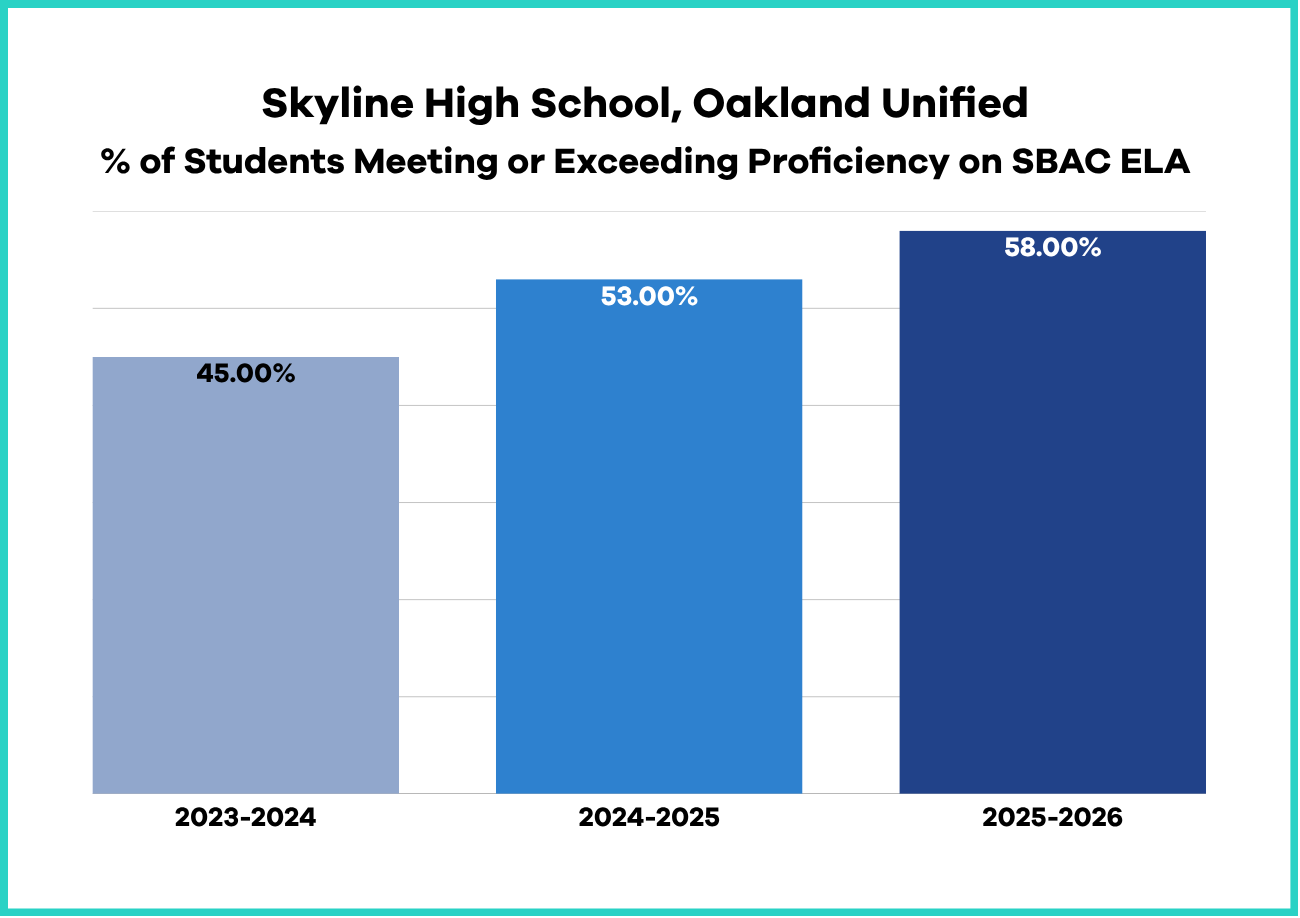
Some schools are starting to see more significant gains. At Skyline High School, the percentage of students meeting or exceeding standards on SBAC ELA grew from 45% to 58% in the three years since launching Fishtank ELA. The number of students scoring in the highest level on the iReady benchmark assessment doubled this past year. These results are promising and are helping to build buy-in.
Looking Forward
Three years into the rollout, what Michelle and Lizzie hope for is bigger than any single test score. It's a generation of Oakland graduates who don't hit a wall in their sophomore year of college.
"What we're doing now," Michelle says, "we're hoping to bridge some of that. So that when kids get there, when they enter the university or the job market, they come in more ready."
Building the foundation for that future means continuing to invest in teacher collaboration, refining how Socratic seminars are coached across buildings, and honoring the teachers who carried Oakland's ELA program through 20 years of going it alone.
It also means trusting what their own students told them: rigor, when it's paired with great texts and real conversation, is something students will rise to meet.
Related Blog Posts
Fishtank School Spotlight: Bradley Elementary and Boston Public Schools
Read how Bradley Elementary School in East Boston, Massachusetts, jumped from 33rd to 84th percentile by giving all students—not just some—access to rigorous, culturally relevant ELA curriculum.
Why Grade-Level Content is Key to Closing Opportunity Gaps
Is your differentiation creating an artificial ceiling on student achievement? See how HQIM and grade-level content with built-in scaffolds drive standards mastery for all students.

